Øre, 5 dele - eAnatomi

Ear, anatomical model in 5 parts

$215.00
Sale price  $215.00 Regular price 
Skip to product information
Øre, 5 dele - eAnatomi
1/7

Ear, anatomical model in 5 parts

SKU: 1000251

Produktet er udgået af vores faste sortiment. Søger du specifikt dette produkt? Kontakt os for mere information.

The product is no longer part of the permanent assortment

If you are interested in this product, we would be happy to check if we can source it for you. Please contact us.
Description

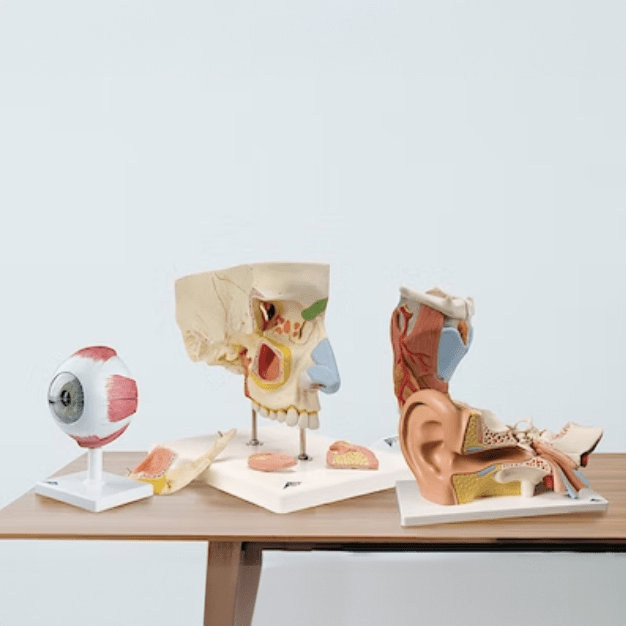
This model shows in a high level of detail the structure of both the outer ear, the middle ear and the inner ear. Since the model can be separated into several parts, it is possible to examine even the smallest structures, thereby gaining an understanding of the ear's complex anatomy.


The model is enlarged 3 times compared to the size of a natural ear, has the dimensions 34 x 16 x 19 cm (width x height x length) and weighs approx. 1.4 kg.


In total, the model can be separated into 5 separate parts, and it is delivered on a white plastic stand.

Anatomically speaking

Anatomically speaking, the model can be used to understand the structure of the entire ear, consisting of the outer ear with the auricle and the external ear canal, the middle ear and the inner ear. In addition, the eustachian tube (tuba auditoria) is seen, which communicates with the nasopharynx, as well as the location of the ear in the temporal bone (os temporale).


The model can be separated into 5 separate parts as follows:


The front part of the temporal bone can be removed so that the inside of the external ear canal becomes visible.
The upper part of the temple bone can also be removed
The eardrum (membrana tympanica) with the three middle ear bones - the hammer (malleus), the anvil (incus) and the stapes - can be removed and examined
The organ of hearing and balance can be removed


In the inner ear, the organs of hearing and balance are illustrated with associated nerves (N. vestibulocochlearis). The model shows both the arch canals (canales semicirculares), the vestibulum and the cochlea (the cochlea).


Of other structures, the oval and the round window (fenestra vestibuli and fenestra cochleae) can be seen on the back wall of the middle ear, and it is also seen how the middle ear is related to the A. carotis interna.

Movement-wise
Clinically speaking

Clinically speaking, the model can be used to understand ear diseases such as otitis media, cholesteatoma (bone eater), perforated eardrum and bullous myringitis.


Furthermore, the ear model can be used to understand examination methods and treatments such as the installation of a drain (tympanic membrane drain).

Contact us

Our anatomical product range
Raffle for free products

All recipients of our newsletter are entered into raffles for free products. Sign up today and be in the running!