

Mini skeleton with flexible joints and nerves on hanging stand
$147.00
Skip to product information


Mini skeleton with flexible joints and nerves on hanging stand
SKU:
EA-A105H
This product cannot be ordered online. Please contact us for more information.
If you are interested in this product, we would be happy to check if we can source it for you. Please contact us.
Description
If you are looking for a skeleton in a particularly practical size, which is at once small, breathtaking, detailed and sold at an attractive price, we highly recommend this model. It is also popular with our customers.
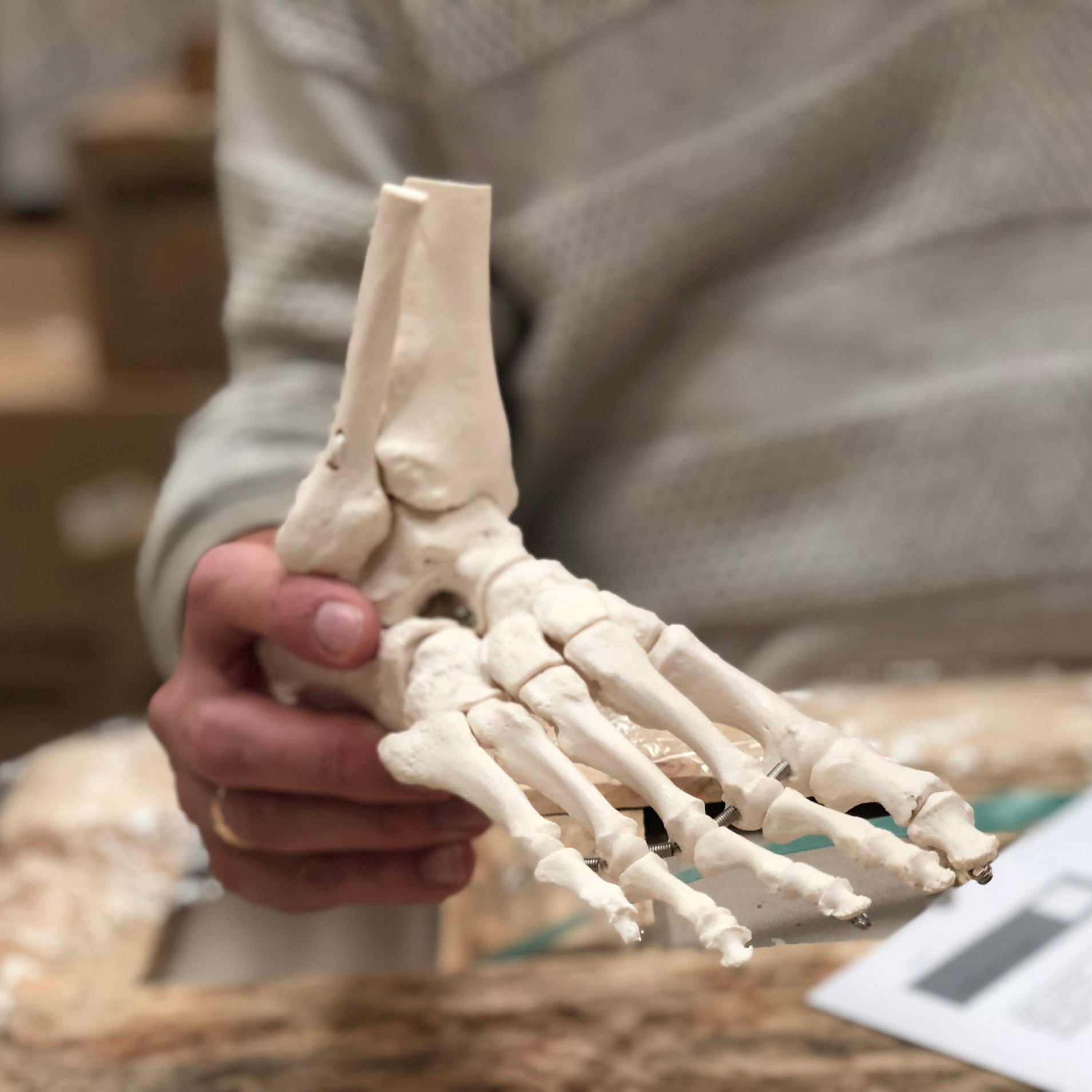
The mini skeleton measures 85 cm in height. The quality of the bone casts is good and suitably solid for general. use. The level of detail on the bones is impressive compared to the standard within mini skeletons. Most joints are held together by metal and/ plastic. Shoulder and hip joints, on the other hand, are fitted with elastics, which allows demonstration of the joints' natural movements.
This version of the mini skeleton model comes with spinal nerves, a visible herniated disc in the lower back and the ability to bend the spine.
NB: This version of the mini skeleton model is delivered hanging on a white metal stand (via a hook in the skull). This means that the skeleton can be taken down from the stand and used for a wide range of demonstrations on, for example, balls, in a lying position or on a chair/cardboard box (as shown in one of the pictures on the left).
Recommendation from Trine Rosenberg, Rosenberg Institute
"For some time I have had the new skeleton from eAnatomi on trial, and my conclusion is that I can recommend this 85 cm high skeleton .
Anatomically, it is lifelike. In particular, the spinal nerves and disc herniation on the skeleton make it easier to explain the damage that can be caused to the nerves, partly by scoliosis (S-shaped) and partly by too much sway.
Because the skeleton has a flexible spine , it is much easier to explain to the client how the above-mentioned injuries can affect the nerves and cause pain in the back, head, neck, legs and arms. On several of the courses at the KST Academy (including the course "Straight back and neck"), different techniques are reviewed in the teaching.
The connection between injury, cause and symptom becomes more visible, and makes it easier for the therapists to explain the situation to the clients.
The best greetings
Trine Rosenberg, teacher and head of the KST Academy, Silkeborg".
Anatomically speaking
Movement-wise
Clinically speaking
Our anatomical product range


Raffle for free products
All recipients of our newsletter are entered into raffles for free products. Sign up today and be in the running!