Head and neck, 5 parts

Head and neck, 5 parts

8.830,00 kr
Sale price  8.830,00 kr Regular price 
Skip to product information
Head and neck, 5 parts
1/7

Head and neck, 5 parts

SKU: 1000214

Produktet er udgået af vores faste sortiment. Søger du specifikt dette produkt? Kontakt os for mere information.

Description

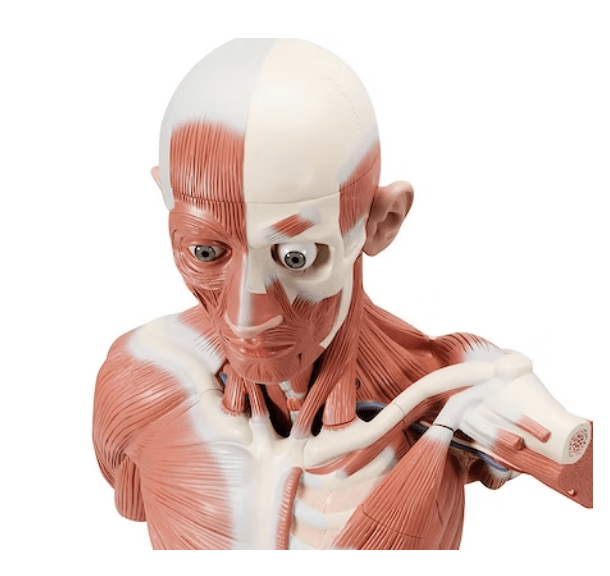
With this model, you get a complete overview of the anatomy of the head and neck. The model illustrates both the superficial and deeper musculature, and also shows vessels and nerves in relation to these.


The model can be separated into 5 parts, as the top of the skull can be removed, and the brain can be removed and separated into 3 parts.


The model has the dimensions 36 x 18 x 18 cm (height x length x width), weighs 2 kg and is delivered on a white stand, which is also removable.

Anatomically speaking

Anatomically, the model can be used to gain an understanding of many different anatomical structures.


First of all, the model illustrates a large number of muscles from the head and neck muscle groups:


The mimic facial muscles
The muscles of mastication
The supra- and infrahyoid muscles
The superficial neck muscles
The scale group
Some back muscles
In relation to this, the largest vessels can be seen that run in relation to the muscles. In the face, only the arteries are shown, while the largest veins on the neck are included.


The model depicts all 12 cranial nerves and in addition the brachial plexus and nerves that depart from the cervical plexus can be seen.


When the top of the skull is removed and the brain is removed, the inside of both the top and bottom of the skull is visible. When the brain is separated into 3 parts, the following structures can be seen, among other things:


telencephalon
cerebellum
The midbrain (diencephalon - with, among other things, the thalamus, hypothalamus, epithalamus and corpus mamillare)
The brainstem
The ventricular system

Movement-wise
Clinically speaking

Clinically speaking, the model can be used to understand disease problems related to the muscles, vessels, nerves and surrounding structures of the head.


For example, facial paresis, formation of salivary stones in the salivary glands (carotid stenosis), and disorders related to the jaw muscles and jaw joint such as temporomandibular dysfunction.


Furthermore, the model can be used to understand lesions and disorders in specific areas of the brain. Examples are epilepsy, brain tumors, hydrocephalus, lesions involving cranial nerves and sclerosis (multiple sclerosis).

Contact us

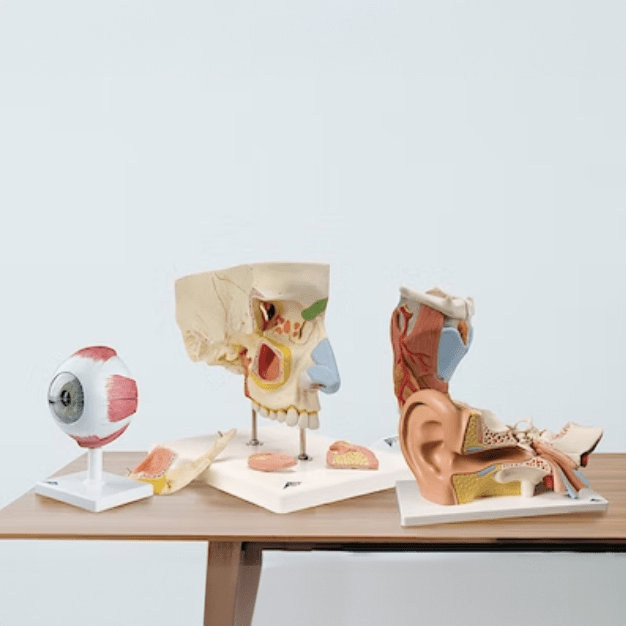
Our anatomical product range
Raffle for free products

All recipients of our newsletter are entered into raffles for free products. Sign up today and be in the running!