

The human skeleton has always fascinated both researchers and design enthusiasts, and interest in skeleton posters has grown significantly in recent years. In this guide, you will get a complete introduction to skeleton posters in 2025, where we review everything from selection and use to the anatomical details that make the posters unique.
Skeleton posters unite science, art and learning across education and interior design. You will gain insight into the history behind anatomical illustrations, modern uses, selection criteria, materials, pedagogical value and practical buying tips.
Let yourself be inspired and find the right skeleton poster for your needs.
The History and Development of the Skeleton Poster
From Leonardo da Vinci to Modern Anatomical Illustrations
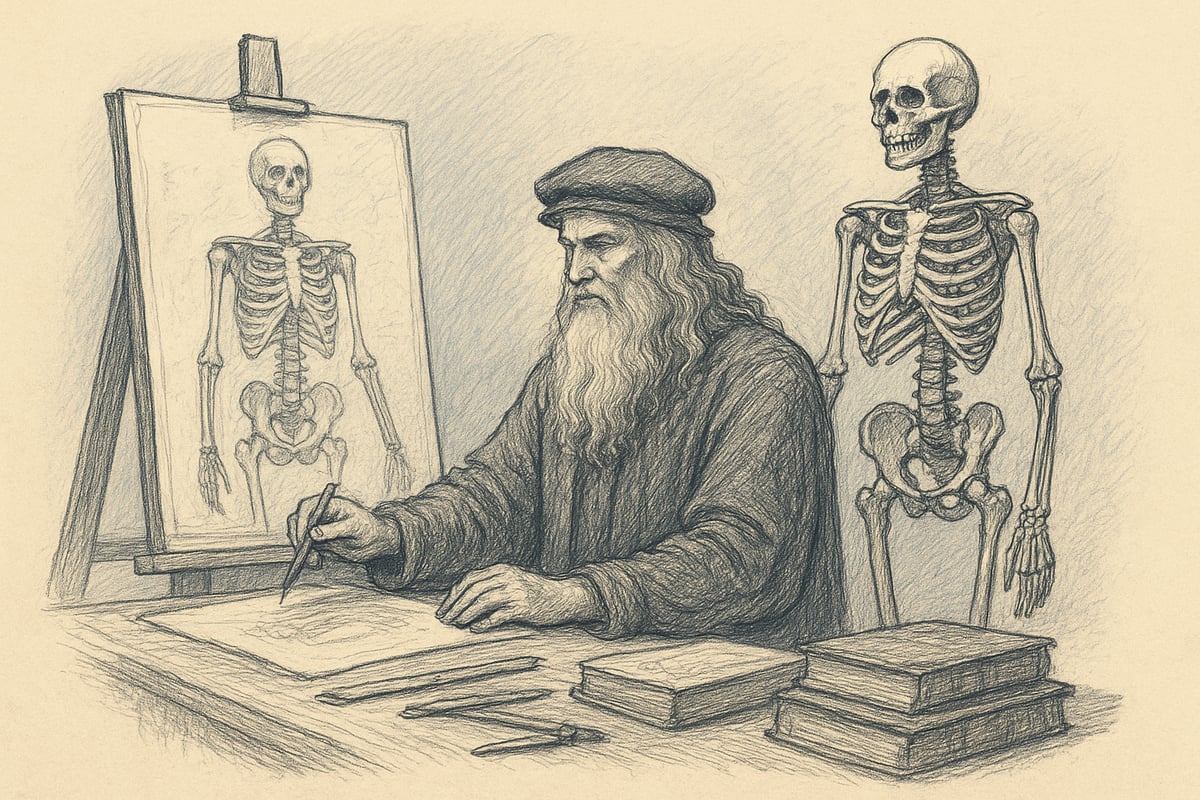
The history of the skeleton poster begins in the Renaissance, when Leonardo da Vinci revolutionized anatomical illustrations with detailed hand-drawn studies of the human skeleton. His work laid the foundation for how the skeleton poster became an important tool in medical education. In the following centuries, anatomical drawings became more widespread, including through pioneers such as Andreas Vesalius, who made the illustrations more scientifically accurate.
As printing techniques improved, skeleton posters could now be mass-produced, making them available to universities and hospitals throughout Europe. The transition from artistic reproductions to precise, targeted posters strengthened their role as a teaching tool. Many Danish institutions have since developed their own traditions, as can be seen inThe History of eAnatomy and Posters , where Danish design and professionalism are highly valued.
The skeleton poster thus became a link between art, science and learning, and has since developed into both a pedagogical and aesthetic object.
Technological Advances and Digitalization
Advances in technology have had a major impact on skeletal posters and anatomical illustrations. The introduction of digital illustration and 3D modeling has made it possible to create posters with far greater precision and more detail than ever before. Digital skeletal posters allow you to zoom in on individual parts, rotate models, and interact with the content in a way that was not possible before.
The benefits of digitalization are clear:
- Updated and correct anatomical information
- Easy access via apps and online platforms
- Possibility of interactive learning and animations
- Adaptation to different teaching levels
Over the past five years, sales of digital skeleton posters have increased significantly, especially among students and educators. Popular digital platforms such as 3D4Medical and Visible Body have made it easy to integrate digital solutions into teaching. At the same time, digital posters have made it possible to update content quickly, ensuring that users always have access to the latest knowledge.
Modern digital skeleton poster combines the best of classical anatomy with today's technological possibilities, creating optimal learning conditions.
The Importance of Scientific Correctness
Scientific accuracy is essential for any skeleton poster, whether used in education or research. Accurate illustrations ensure that students and professionals gain a reliable understanding of the structure of the body. That's why many manufacturers work closely with medical experts to guarantee quality.
There are international standards and certifications that must be met before a skeleton poster can be used in professional contexts. Famous illustrators such as Peter Bachin have set new standards for both accuracy and communication. Quality control and continuous updating help ensure that modern skeleton posters always meet the highest requirements.
The precision not only supports learning, but also strengthens confidence in the poster as a scientific tool.
Collectibles and Vintage Skeleton Posters
Vintage skeleton posters have gained increasing interest as collectibles and decorative elements. Original posters from the 19th and 20th centuries are sought after by both collectors and individuals who want a unique feature in their home or office. The price of well-preserved vintage skeleton posters has increased significantly in recent years, especially for posters with rare motifs or special printing techniques.
Many people choose to frame vintage skeleton posters to preserve both aesthetics and historical value. The market for collectors ranges from medical museums to design enthusiasts who see skeleton posters as timeless works of art.
This fascination with the skeleton poster of the past emphasizes how science and art go hand in hand, and how historical posters still inspire modern aesthetics.
Modern Uses of Skeleton Posters
Today, skeleton posters are much more than just a teaching tool. Modern skeleton posters are used in many contexts, from classrooms to clinics to private homes. This versatility makes skeleton posters a popular choice for professionals, students and design enthusiasts alike.
Education and Health Sector
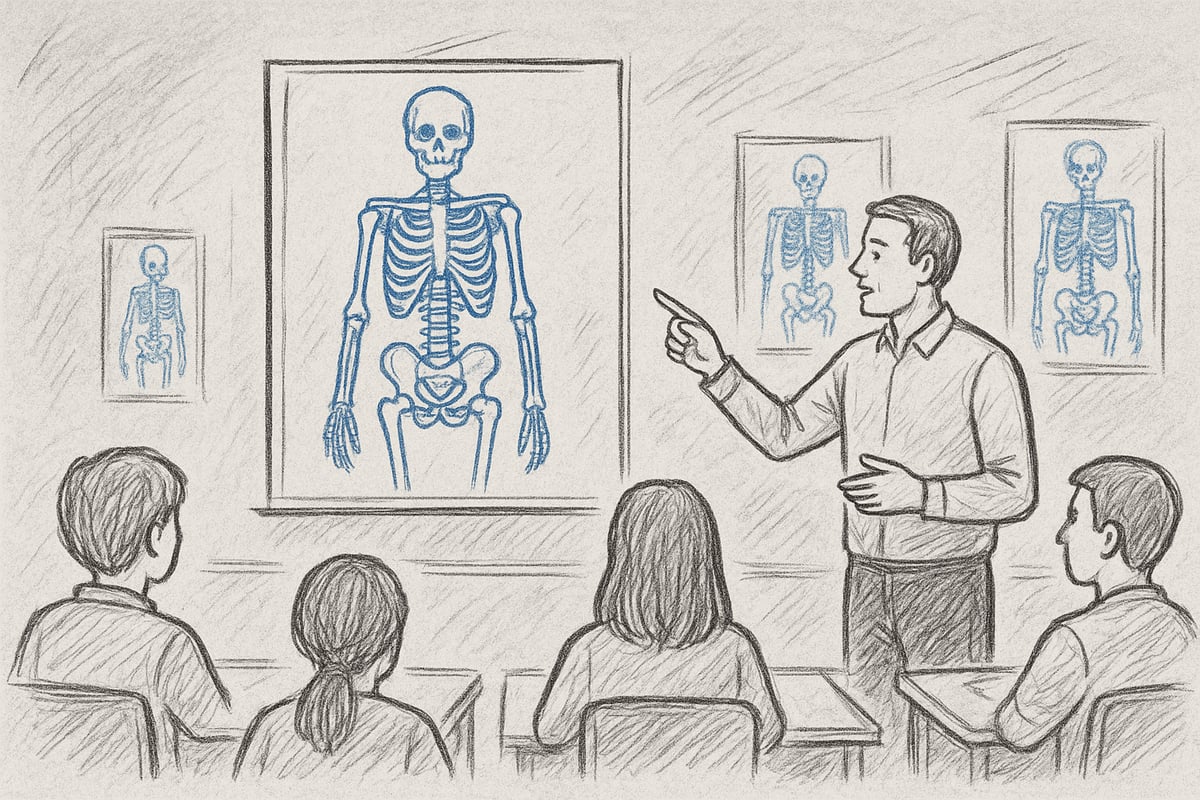
Skeleton posters play a central role in biology and health education at both high schools and universities. Teachers often use skeleton posters to illustrate the structure of the body in an easy-to-understand way. Statistics show that 85% of Danish educational institutions use skeleton posters in teaching.
In hospitals and clinics, skeleton posters are used to explain diagnoses and treatments to patients. A skeleton poster can make complex anatomical topics more accessible to both students and patients.
Examples of use:
- Review of bones in biology lessons
- Patient guidance in case of fractures or joint injuries
- Self-study for medical students
Skeleton posters ensure that teaching and patient communication become more visual and engaging.
Home Decor and Aesthetics
In recent years, skeleton posters have become a popular trend in home decor. Many people choose to hang a skeleton poster in their living room or office to combine scientific interest with modern aesthetics.
Skeleton poster fits into several styles, such as Scandinavian minimalism and industrial decor. The detailed anatomy works as both a conversation starter and an artistic statement in the home.
Popular locations:
- Above the desk
- In the hallway
- As part of a gallery wall
Skeleton posters give the room a unique touch and reflect the resident's curiosity.
Art, Design and Creativity
Skeleton posters serve as a source of inspiration for artists, designers and tattoo artists. Through collaboration between artists and medical experts, unique works are created where accuracy meets creativity.
Some of the most popular skeleton poster projects are displayed in galleries and exhibitions. The Danish design tradition has left its mark on modern skeleton posters, where both aesthetics and science are highly valued. Read more about Anatomical posters designed in Denmark to understand this development.
Skeleton posters are also used as a reference in creative processes, e.g. in fashion, graphic design and tattoo art.
Educational Tools for Children and Young People
Skeleton posters for children are often designed with colors and simplified illustrations. In elementary schools, a skeleton poster makes it easier for students to understand the structure of the body. Many children's rooms are now adorned with a colorful skeleton poster, which arouses curiosity and the joy of learning.
Benefits of skeleton poster for children:
- Visual learning strengthens memory
- Make complex topics accessible
- Creates a fun and inspiring learning environment
A skeleton poster can be included in small tasks or quizzes and support the dialogue between child and adult.
Specialized Applications: Physiotherapy and Chiropractic
A skeleton poster is often hung in the treatment rooms of physiotherapists and chiropractors. It is used to explain injuries, treatments and rehabilitation to the patient. A skeleton poster helps to visualize problem areas and make the treatment process more understandable.
Examples:
- Explanation of the function of the spine
- Overview of joints and muscles in sports injuries
- Planning exercises and rehabilitation
Skeleton poster is an indispensable tool for healthcare professionals who want to strengthen patient insight and motivation.
How to Choose the Right Skeleton Poster
Choosing the right skeleton poster requires an overview of both aesthetic and practical considerations. Whether you are looking for a poster for teaching, clinic or home, it is important to know the key selection criteria. Here you will get a complete guide to help you safely through the decision-making process.
Size, Format and Location
When choosing a skeleton poster, you should first consider where it will be placed. The most common sizes are 51x66 cm and 100x70 cm, which are suitable for both classrooms and waiting rooms. Smaller formats are often preferred for the home, while larger posters provide a better overview in educational environments.
The placement is very important for visibility and functionality. Hang the poster at eye level so that details can be easily read. Also consider whether there is room for several posters side by side if you want to compare different parts of the skeleton. An optimal skeleton poster is not only informative, but also an integral part of the room.
Materials and Print Quality
The choice of material is very important for both the durability and the look of your skeleton poster. Paper posters are affordable and easy to hang, but more vulnerable to wear and moisture. Laminated posters protect against dirt and can be used with whiteboard markers, which is ideal for teaching.
Canvas posters combine an exclusive look with extra durability. The print quality determines how clearly the anatomical details appear, and a high resolution ensures sharp colors and precision. Always choose a skeleton poster with UV-resistant printing to avoid fading.
| Material | Advantage | Disadvantage |
|---|---|---|
| Paper | Cheap, easy | Vulnerable, short lifespan |
| Laminated | Robust, writable | More expensive, reflects |
| Canvas | Exclusive, durable | Heavy, more expensive |
Language, Nomenclature and Target Group
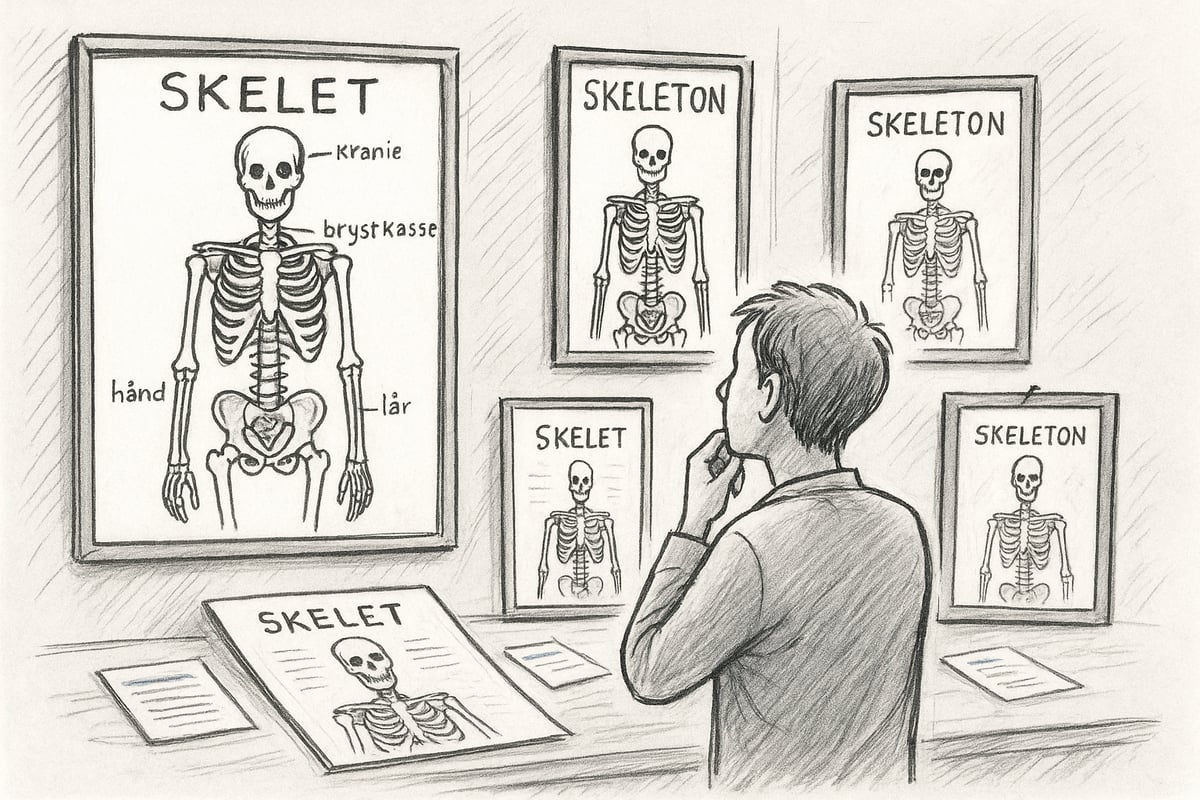
The language choice on your skeleton poster should reflect the target audience. Posters with Danish text are ideal for primary schools, while Latin and English are often used at universities and in the healthcare sector. For children, simplified versions with color codes are available to make learning more intuitive.
Professionals and students typically need posters with precise terminology and detailed descriptions. Consider whether you want explanatory text, color coding, or additional illustrations. A skeleton poster that matches the recipient's level increases both understanding and engagement.
Scientific Accuracy and Source Material
It is crucial that a skeleton poster is based on recognized anatomical sources. Certified posters are often developed in collaboration with medical experts and ensure that proportions and naming are in line with current standards. Well-known illustrators such as Peter Bachin guarantee high professional quality.
Always check if the manufacturer states the use of original sources and updated anatomical data. A correct skeletal poster contributes not only to learning, but also to correct patient information and research. Choose carefully to ensure credibility.
Price, Offers and Buying Guide
The price of a skeleton poster depends on size, material and print quality. Paper posters often start at 100 DKK, while laminated and canvas versions can cost up to 600 DKK. Many retailers offer sets with volume discounts, which is advantageous for teaching or clinics.
To find the best deal, it is recommended to compare several suppliers and keep an eye out for outlet products. You can get a good overview of different types and uses via this overview of anatomical skeleton posters . Always choose quality over price, as a durable and accurate skeleton poster is an investment in both knowledge and aesthetics.
Educational and Professional Value of Skeleton Posters
A skeleton poster is much more than a visual supplement in the classroom. It functions as a central tool that makes complicated anatomical relationships easier to understand for students, teachers and healthcare professionals alike. Through clear illustrations, a bridge is created between theory and practice, which strengthens both learning and professional insight.
Understanding and Visualizing Anatomy
A skeleton poster makes it possible to visualize the structure of the body in a clear way. When students see an anatomical illustration, it becomes easier to understand how bones, joints and structures are connected.
This visual approach supports the learning process, as many people find it easier to remember and understand complex topics when they are presented graphically. In teaching, skeleton posters are often used as a starting point for dialogue and discussion, which strengthens both understanding and collaboration.
For example, the teacher can point directly to specific parts of the skeleton and relate them to everyday movements or injuries, making anatomy more tangible and relevant for students at all levels.
Support for Exams and Self-Study
A skeleton poster is an indispensable tool for students preparing for exams. The poster acts as a visual reference, where they can quickly repeat the names and locations of the bones. Statistics show that 70% of medical students use visual aids such as posters in their self-study.
Group work around a skeleton poster promotes collaboration and dialogue, as everyone can point, ask questions and explain directly on the illustration. For those who want more tips for exam preparation, there is astudent guide to anatomy posters , which provides practical advice for effective use.
By having a skeleton poster hanging in the room or in the study group, a constant focus on anatomy is created, which increases the chances of remembering important details for the exam.
Patient Communication and Outreach
A skeletal poster is also a powerful tool in the healthcare sector, where it is used to explain diagnoses and treatments to patients. When a physiotherapist or chiropractor points to the relevant part of the skeleton, it becomes easier for the patient to understand their condition.
This visual communication increases the patient's confidence and understanding, which often leads to better compliance and collaboration on the treatment plan. In general practice and clinics, skeleton posters create a common point of reference that strengthens the dialogue between practitioner and patient.
Examples from clinics show that patients often ask more and more relevant questions when they see their problem directly on the poster. This makes communication more effective and engaging.
Motivation and Engagement in Learning Environments
Skeleton posters help create a motivating and engaging learning environment. The visual presence arouses curiosity, and many students are inspired to ask questions and investigate the anatomy of the body more closely.
Posters can also be used as a starting point for interactive tasks, such as identifying specific bones or discussing their function, which increases both participation and learning.
In the classroom, the skeleton poster serves as a natural gathering point where students and teachers can meet about academic topics. It promotes dialogue, creates engagement and strengthens the pedagogical value of teaching.
Overview of Popular Skeleton Posters in 2025
The skeleton poster market has developed significantly in recent years. Today, there is a wide selection, covering everything from classic motifs to advanced digital solutions. Here you will get an overview of the most popular types, manufacturers and trends for 2025.
Classic Skeleton Posters
Classic skeleton posters such as “Skeleton” by Peter Bachin remain among the most sought-after. Their simple and clear design makes them ideal for both teaching and clinical use. Many choose these as they provide an easy-to-understand visual overview of the entire skeleton.
Statistics show that classic motifs are still among the best-selling skeleton posters in Denmark. They are used especially in schools, universities and the healthcare sector, where recognisability and easy readability are highly valued. Classic posters often serve as a standard reference in both teaching and daily practice.
Thematic and Specialized Posters
A themed skeleton poster can focus on specific parts of the body, such as the skull, spine, or hands and feet. This makes it easier to delve into details that might otherwise be lost in the big picture.
Specialized posters are widely used in research and special education, where the need for detailed knowledge is great. The advantage of these is that they can illustrate complex anatomical structures more precisely. Many teachers therefore supplement with thematic skeletal posters, so that students get a more nuanced insight into the structure of the body.
Modern and Digital Skeleton Posters
Digital trends have made their way into the skeleton poster market. Interactive posters, augmented reality and animations are gaining popularity, especially among younger users and on digital platforms. These solutions are easy to update and can integrate multiple learning layers.
Popular digital products allow you to zoom in on details and customize the display as needed. Many choose modern posters that combine science and aesthetics, such as anatomical posters designed in Denmark . These solutions provide a new dimension to interior design and learning.
Comparison of Brands and Manufacturers
When choosing a skeleton poster, the manufacturer is crucial for both quality and design. Well-known brands such as Anatomical Chart Company offer a wide selection, ranging from classic to modern variants. There are differences in materials, level of detail and price level.
| Mark | Design style | Quality | Price level |
|---|---|---|---|
| Anatomical Chart Company | Classic/Modern | High | Between |
| eAnatomy | Danish, modern | High | Medium/High |
| Miscellaneous no-name | Simple/traditional | Varies | Low |
Tips for selection: Consider both design, language and material choice when comparing skeleton posters from different manufacturers.
eAnatomy: Danish Expertise in Anatomical Posters
eAnatomi ApS represents Danish expertise within skeletal posters and anatomical illustrations. The company collaborates with healthcare experts to ensure high scientific accuracy in all products. The range is wide and also includes posters for veterinary use and special orders.
The advantages of eAnatomi are Danish design, great detail and the possibility of customized solutions. Customers include students, teachers and clinics both in Denmark and internationally. Their skeleton posters are particularly sought after for their combination of aesthetics and professional value.
Practical Tips for Setup and Maintenance
Getting the most out of your skeleton poster requires careful setup and maintenance. Whether you use the poster for teaching, clinical use, or as decoration, a professional approach can significantly extend its lifespan.
Framing and Mounting
Framing protects your skeleton poster from dust, dirt and damage. Choose a frame that both matches the decor and ensures stability, especially if the poster is hanging in a classroom or waiting room.
Hanging can be done with traditional nails, picture hooks or modern solutions such as magnetic strips. For additional inspiration for professional hanging, see Anatomical Posters for Teachers , where several practical examples are presented.
Also consider creative hanging options, such as clips or cords, if you want flexibility or often change locations.
Cleaning and Maintenance
To keep your skeleton poster looking good, you should wipe it down regularly. Laminated posters can be cleaned gently with a damp, soft cloth. Never use harsh cleaning agents as they can damage the surface.
Paper posters require extra care. Remove dust with a dry, soft brush. Avoid direct sunlight as the colours may fade. Moisture and high temperatures can damage both the paper and the print.
With proper maintenance, a skeleton poster can maintain its quality for many years, no matter where it is used.
Storage and Transport
When your skeleton poster is not in use, it should be stored rolled up in a sturdy poster tube. This protects against creases, cracks and dust. Always use acid-free paper or plastic for wrapping so that the print does not deteriorate over time.
When transporting, especially between classrooms, it is recommended to use sturdy tubes and avoid placing heavy objects on top.
If you lend the poster, it might be a good idea to clearly label the poster tube so that it can be easily identified.
Recycling and Sustainability
Consider the environment when choosing and disposing of your skeleton poster. Many manufacturers offer posters printed on FSC-certified paper or with vegetable-based inks.
When the poster has served its purpose, it can be donated to schools, libraries or recycling centers. Some materials can be sorted as paper or plastic, depending on the print.
By choosing sustainable solutions, you contribute to more responsible consumption, while also enjoying your skeleton poster for a longer period of time.
Now that you have gained insight into the history of the skeleton poster, modern applications and the most important selection criteria, you have a solid basis for making the right choice for both learning and interior design. Whether you are a student, teacher or just fascinated by anatomy, at eAnatomi you can find carefully selected posters developed in collaboration with professionals. Here you get access to Danish design, high quality and tailor-made solutions for every need.
Do you want to explore the full selection and find exactly the poster that matches your wishes?
Read more here
0 comments