

In both the clinic and the classroom, it is crucial to be able to understand the body's nervous system visually. A dermatome poster could become your most important tool in 2025 when making complex anatomical relationships simple and accessible. Dermatomes are central to diagnosis, treatment and communication with patients. This article guides you to understand and use a dermatome poster, so you have an effective visual tool. You will gain insight into what dermatomes are, how to use the poster, its structure, benefits and concrete examples from practice.
What are dermatomes?
To understand the value of a dermatome poster, it is necessary to first understand dermatomes and their role in anatomy and clinical practice. Dermatomes provide a visual and systematic understanding of how nerves supply the skin and why symptoms often follow certain patterns.

Definition and anatomy
Dermatomes are areas of the skin that are innervated by one specific spinal nerve. This means that each segment of the spinal cord has its own area of skin from which it receives sensory information. Using a dermatome poster makes this complex division of the body easy to understand.
The spinal cord is made up of several segments: cervical, thoracic, lumbar, and sacral. Each segment sends nerves to specific areas of the body. For example, the C6 nerves innervate the thumb area, while the L5 nerves control the outside of the lower leg. This segmentation can be clearly visualized on a dermatome poster, making it easier to identify which nerve may be affected by certain symptoms.
It is important to distinguish between dermatomes and cutaneous innervation areas. Dermatomes follow a more segmented distribution, while cutaneous innervation areas can overlap and complement each other. For a deeper understanding of the differences, as well as how these areas are illustrated and used in practice, you can read more in this article on dermatomes and cutaneous innervation areas .
Clinically, dermatomes are essential in the assessment of neurological symptoms. In the case of a herniated disc, the patient may experience decreased sensation or pain in a specific dermatome, which helps the doctor to localize the injury. Statistics show that up to 70% of patients with back-related nerve pain have symptoms that follow a dermatomal pattern. Recent clinical-anatomical studies have clarified these areas, which has significantly improved diagnosis. An updated poster on dermatomes integrates the latest knowledge, so that both students and professionals get the most accurate overview.
Why are dermatomes important?
Dermatomes are of great importance in both clinical practice, education and patient communication. A dermatome poster is often used by healthcare professionals to quickly assess where a nerve injury may be located. This is especially true in diseases such as herpes zoster, where rash and pain follow specific dermatomes, and in herniated discs, where sensory disturbances can point directly to the involved segment.
For medical students and educators, understanding dermatomes is essential to being able to connect anatomy with symptom images. Here, a poster about dermatomes makes it visually and pedagogically clear to learn how sensory signals travel from the skin to the spinal cord.
Patients can also benefit greatly from seeing their symptoms illustrated on a dermatome poster. This makes it easier to understand why their pain or sensory disturbances occur exactly where they do. At the same time, it supports communication between patient and therapist when you can point to the relevant area directly on the poster.
Healthcare professionals often highlight that the use of a dermatome poster makes it possible to explain complex relationships in a simple and effective way. Studies show that the use of visual aids in neurological education increases learning by up to 30%. Therefore, an updated dermatome poster is an indispensable tool in both clinical, educational and private use.
Poster about dermatomes: Structure and design
A dermatome poster is much more than just a decorative element. It is a key tool that combines precise knowledge with intuitive communication. To ensure that both students and healthcare professionals get the most out of the poster, its structure and design play a crucial role. Clarity, accessibility and aesthetics are key factors when translating complex anatomical relationships into a visual format that both informs and inspires.

Visual overview and structure
A dermatome poster is typically constructed with a clear and easy-to-read layout. The different body regions, such as cervical, thoracic, lumbar, and sacral, are marked with distinct colors. The visual system of color coding and numbers makes it easy to identify which spinal nerves innervate specific skin areas.
The poster often contains these elements:
- Cover with overview illustration : The entire body is shown from front and back so that all dermatomes can be seen.
- Color codes and numbers : Each region has its own color and number, supporting quick identification.
- Explanatory text boxes : Short and precise descriptions of the individual dermatomes and their clinical significance.
- Illustrations : Graphic elements that highlight transitions between regions and typical clinical areas.
Unlike traditional textbooks, where the information is spread across several pages, a dermatome poster brings together all the essential knowledge in one place. The visual overview reduces cognitive load and makes it easier to learn and remember. Many users emphasize that the minimalist and modern design, which often characterizes Danish posters, contributes to a higher level of understanding and motivation.
According to studies in anatomy education, over 70 percent of students request visual learning aids such as posters. User feedback shows that elements such as clear contrasts, logical division and the use of icons make the poster easier to use in practice. This applies to both the experienced clinician and the beginner student.
Modern posters are developed with a strong emphasis on aesthetics and functionality. Several Danish designers combine pedagogy and visual clarity to ensure that the poster is both decorative and useful. Read more about the design process for anatomical posters designed in Denmark , where both usability and professional accuracy are prioritized.
A poster about dermatomes is thus not just a reference work, but an active learning tool that supports both teaching and clinical work.
Development and professional basis
The development of a dermatome poster requires close collaboration between physicians, anatomy educators, and graphic designers. To ensure that the poster meets both scientific and pedagogical requirements, each element undergoes thorough professional validation.
A good example of this process is the collaboration with physician and educator Alexander Kai Thomsen, where clinical experience and the latest research are combined. The poster is continuously updated as new knowledge from clinical-anatomical studies becomes available. This means that both illustrations and explanatory text reflect the latest standards in neurological diagnostics.
Critical literature searches are an integral part of the development work. Each dermatome area is checked against international consensus and validated sources. This ensures that a dermatome poster can be used safely in both teaching and clinical settings.
Furthermore, interdisciplinary collaboration is essential. Illustrators, doctors, and educators work together to create a poster that is both anatomically correct and pedagogically effective. Consensus processes minimize the risk of misunderstandings and ensure that every detail is worked out.
A dermatome poster must be robust enough for everyday use while presenting the information in a way that motivates learning. Therefore, the layout and content are often tested by both students and experienced clinicians before the poster is finally approved.
When you choose a poster about dermatomes, you can be sure that it is based on updated knowledge and a solid academic foundation. This makes the poster an indispensable resource in both professional and educational contexts.
How to Use a Dermatome Poster: Step-by-Step Guide
Getting the most out of a dermatome poster requires both an understanding of its structure and knowledge of how to best integrate it into practice. Follow this detailed step-by-step guide to utilizing the poster effectively in clinical, educational, and personal use.
Step 1: Identify the need
First, you need to clarify why a dermatome poster is relevant to your specific situation. Is it for patient guidance, neurology education, or self-study?
Consider the following scenarios:
- Clinical use in the study of sensory disturbances or pain
- Teaching where complex neural pathways are to be visualized
- Home study where repetition of dermatomes is necessary
A dermatome poster provides a quick visual overview that makes it easier to understand the connections between symptoms and nerves. Identifying the purpose ensures that you get the most out of the poster.
Step 2: Location and setup
The placement of your dermatome poster has a big impact on how often and effectively it is used. Think about the rooms where the poster will be most visible and accessible.
Good locations include:
- Clinic rooms where patients and staff have easy access
- Classrooms where it can be included in presentations
- Home office or study space for daily rehearsal
Make sure the poster is at eye level, well lit, and not covered by other material. An easily accessible poster about dermatomes promotes both learning and application in practice.
Step 3: Understand the poster
To make the most of your dermatome poster, you need to learn how to read its structure. Color codes and numbers mark the individual dermatomes and their associated spinal nerves.
Important elements on the poster:
- Color codes for the different regions (cervical, thoracic, lumbar, sacral)
- Numbering that follows the segments of the spine
- Symbols and abbreviations, which are explained in the poster
If you want additional visual tools or illustrations, you can supplement with online resources such as Dermatomer – MedEasy , which offers interactive overviews and helps to understand the distribution on the body.
Step 4: Application in practice
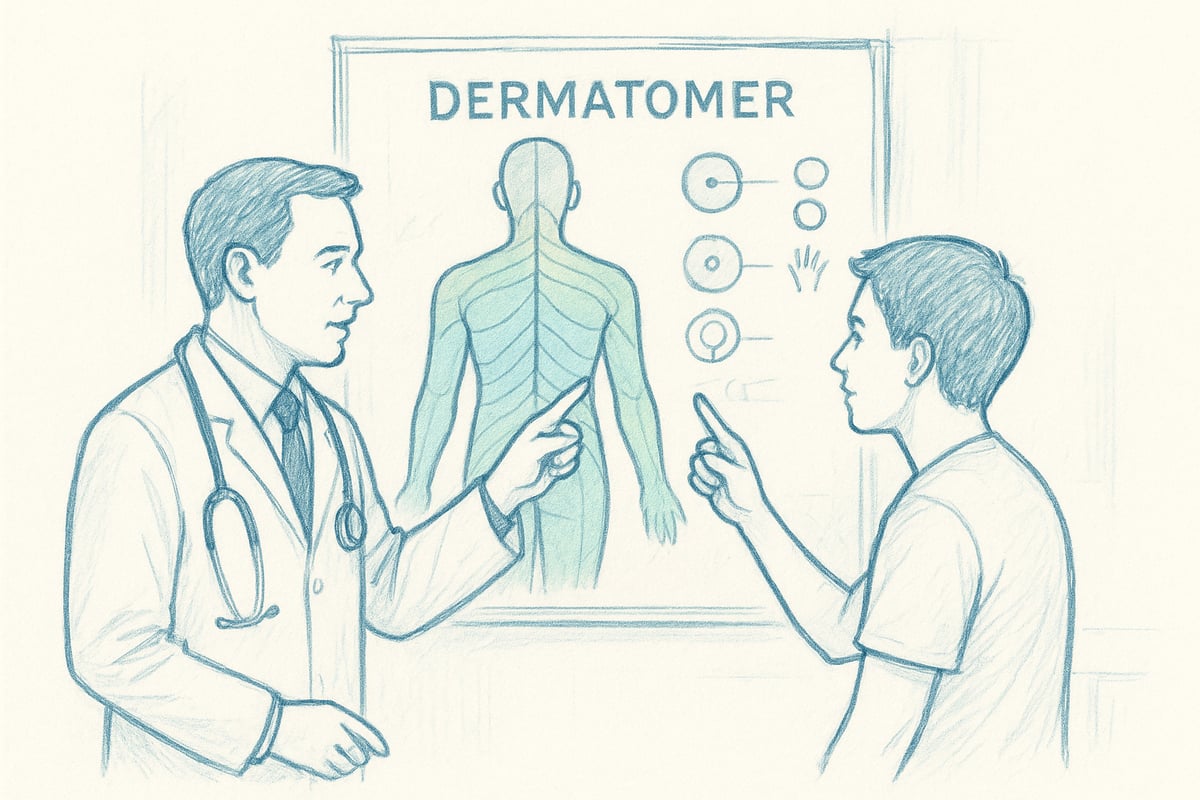
Now you can start using the poster actively. When examining patients, you can point to relevant areas and discuss symptoms based on the dermatomes.
Example: A patient experiences decreased sensation on the outside of their lower leg. By matching the area on your dermatome poster, you can quickly locate which spinal nerves may be affected.
In teaching, the poster can be used to visualize nerve pathways, discuss clinical cases, and reinforce understanding of anatomical relationships, making complex topics more tangible.
Step 5: Combine with other learning tools
To maximize learning outcomes, it is recommended to combine your dermatome poster with other educational tools.
Options include:
- Anatomical models of the spine or skin
- Apps that visualize the nervous system digitally
- Videos or online courses on neurology
Multimodal learning strengthens memory and allows for the ability to see relationships from multiple angles. The poster serves as a fixed point of reference in this process.
Step 6: Update and maintenance
It is important that your dermatome poster is based on the latest knowledge. Anatomical knowledge is evolving, and updated posters ensure that you are working with correct information.
Good advice:
- Check the publisher's year and references
- Replace the poster if new clinical guidelines are issued.
- Clean the poster regularly with a soft cloth to ensure long life.
An updated poster about dermatomes maintains its professional and educational value over time.
Typical mistakes and how to avoid them
Although a poster about dermatomes is a powerful learning tool, some typical misunderstandings are seen.
Please note:
- Confusing dermatomes with cutaneous innervation areas
- Overlooking variations between individuals
- Misinterpreting color codes, especially with complex layouts
To avoid mistakes, always read the poster carefully and use it as a supplement to clinical knowledge. Ask colleagues or teachers if in doubt and always compare with the patient's symptoms.
Benefits of using a dermatome poster
Using a dermatome poster offers many benefits, whether you are a healthcare professional, student, educator or patient. This visual tool makes complex neurological relationships easy to understand and apply in practice. Below we review how a dermatome poster can enhance learning, communication and diagnostics across target groups.

For healthcare professionals
A dermatome poster serves as a quick and reliable reference tool in the clinic. It makes it easy to locate and assess neurological outcomes in patients with pain, sensory disturbances or suspected nerve involvement.
When urgent assessment is needed, a dermatome poster can help to quickly identify which spinal segment is involved. It improves patient communication as the visual element makes it easier to explain symptoms and treatment options. For example, the poster can be used to illustrate how pressure on a nerve root after an injury can cause specific symptoms in a specific area of the body.
The poster also supports interdisciplinary collaboration, as all professional groups have a common visual starting point from which to speak.
For students and teachers
A dermatome poster is an indispensable tool in anatomy teaching. It allows you to visualize the connection between the segments of the spinal cord and the areas of the skin they innervate, which significantly enhances understanding.
Students find that complex topics become more tangible when they can see, touch, and point to a physical poster about dermatomes. For educators, the poster provides pedagogical freedom to explain, quiz, and engage the class. Statistics show that the use of visual learning aids such as posters has increased significantly in anatomy teaching in recent years.
If you want to know more about how posters enhance learning, you can read about anatomical posters for students .
For patients and individuals
Patients and individuals also benefit greatly from a poster about dermatomes. It makes it possible to understand one's own symptoms and follow the course of treatment in a new way.
When the doctor points to the poster and explains why certain areas are numb or painful, the patient's insight and confidence are strengthened. Many use the poster at home to monitor progress, explain symptoms to relatives or prepare for consultations.
A poster about dermatomes can therefore increase the patient's understanding and engagement in their own health.
Comparison with other learning methods
A dermatome poster has several advantages compared to traditional textbooks and digital solutions. The table below provides an overview:
| Learning method | Advantages | Disadvantages |
|---|---|---|
| Poster about dermatomes | Visual, fast, easy access | Requires physical space |
| Textbook | In-depth explanations | Can seem confusing |
| Digital app | Interactive, updatable | Requires device and power |
Combined use of posters, books and digital tools provides the most complete learning. The poster acts as an anchor point in both teaching and clinical practice.
Aesthetic and practical value
A dermatome poster is not only functional, but also aesthetically pleasing. The modern design ensures that the poster fits into clinics, classrooms and homes alike.
It contributes to a professional and welcoming environment where learning and dialogue are in focus. At the same time, it is practical, as it is always visible and easy to resort to in a busy everyday life.
Whether you are a professional or a private individual, a poster about dermatomes adds both knowledge and visual value to your space.
Professional quality and updated knowledge in dermatome posters
Up-to-date knowledge is essential for any dermatome poster, as it ensures that both students and healthcare professionals are working with the most reliable information. New clinical-anatomical studies have in recent years led to adjustments in how dermatomes are divided and visually presented. For example, recent research has identified variations in nerve supply, which has meant that several posters are continually updated to reflect this knowledge.
It is important that a dermatome poster does not simply reproduce outdated models, but actively integrates the latest findings from international studies and consensus reports. This ensures that users can trust that their visual reference is in line with modern practice. This is why leading providers such as eAnatomi focus on continuous updating and quality assurance of their materials.
The development of a dermatome poster requires close collaboration between physicians, educators, and medical illustrators. This interdisciplinary process is essential to achieve both pedagogical clarity and professional precision. By bringing together clinical and educational experiences, posters can be created that are easy to understand but still scientifically sound.
Quality assurance involves critical review of sources and the use of international standards. Consensus among experts is necessary to avoid misunderstandings and ensure uniformity in teaching and clinical practice. By combining evidence-based knowledge and visualization, a poster about dermatomes can function as a safe and recognized learning tool. For further background knowledge about dermatomes and their clinical significance, Dermatomer – Store norske leksikon is recommended.
eAnatomi ApS: Your partner for professional dermatome posters
When you want a poster about dermatomes that combines professionalism, pedagogy and aesthetics, eAnatomi ApS is your obvious partner. The company specializes in developing and distributing professional anatomical posters, including posters about the nervous system, which are tailored for both teaching, clinical use and private study.
eAnatomi ApS works closely with healthcare professionals, doctors and educators to ensure that each dermatome poster is based on the latest knowledge and updated clinical standards. This means that you always get an evidence-based learning tool, whether you are a student, teacher, clinical staff or private individual with an interest in anatomy.
With a wide range of products ranging from large format posters to custom-designed solutions, eAnatomi ApS offers something for every need. The posters are developed with a focus on both visual clarity and high pedagogical value, making them ideal for use in classrooms, clinics and home studies. Read more about the many options for anatomical posters for educators if you want to enhance the visual learning environment.
You can easily order your dermatome poster directly at eanatomi.com and benefit from a tool that makes complex anatomy accessible to everyone.
Once you have a solid understanding of how a dermatome poster can make complex anatomy more understandable and applicable in both clinical, teaching and everyday life, the next step is to choose the solution that best suits your needs. At eAnatomi ApS, we collaborate with healthcare specialists to ensure that our posters are always based on the latest knowledge and have a clear, user-friendly design. Whether you are a student, teacher or working in practice, you can find inspiration and order your own dermatome poster here:
Read more here
0 comments