

How do we ensure that anatomy education remains understandable and engaging for students in 2026? The challenge is real, as the body's complex systems require more than traditional methods to be effectively communicated.
This guide provides an updated and practical introduction to the most effective methods in anatomy teaching. You will gain insight into modern didactic principles, digital learning tools, hands-on models, current evaluation methods, and the latest trends.
Are you ready to discover how you can make anatomy teaching both exciting and educational for your students? Read on and get concrete strategies to strengthen your teaching practice.
The Development of Anatomical Teaching: From Tradition to Innovation
Teaching practices in anatomy education have changed significantly in recent years. Understanding the complex systems of the body now requires more than just classical methods. Modern demands from both society and students have pushed for the development of more engaging and effective approaches. The following provides an overview of these developments.
Historical overview and traditional methods
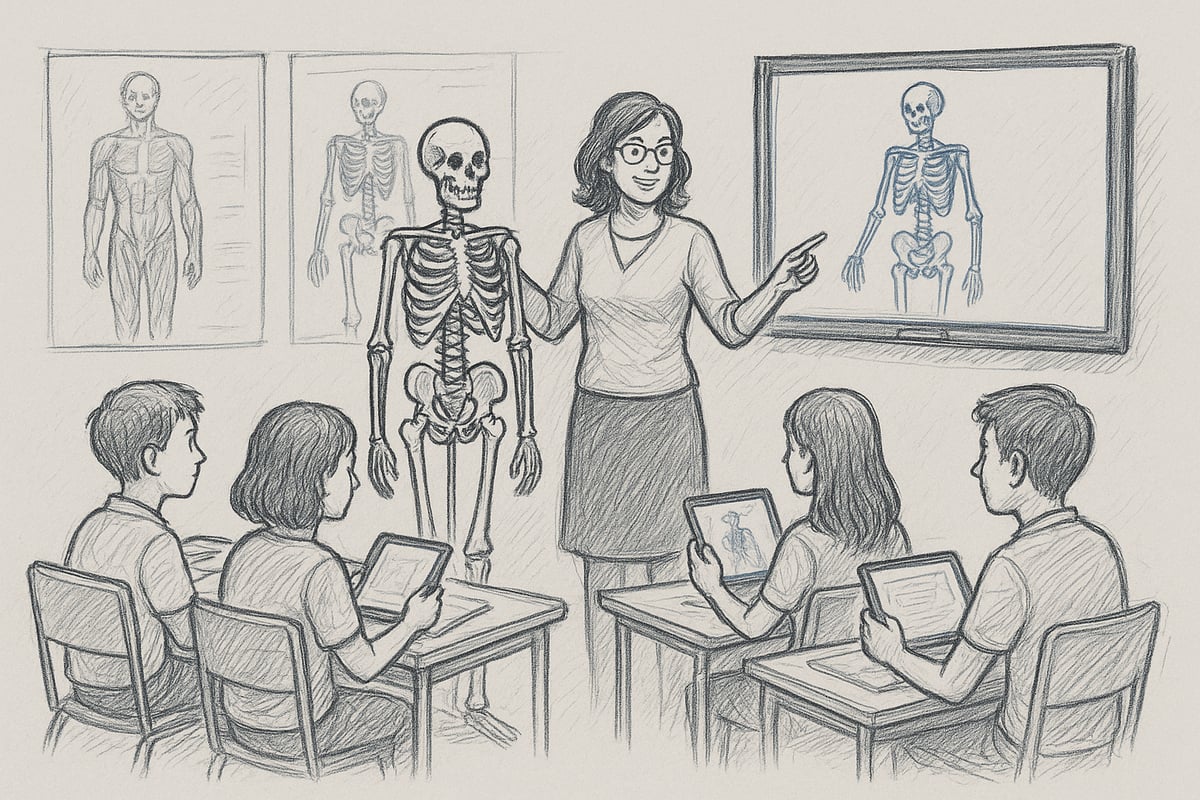
In the past, anatomy education centered around blackboard teaching, textbooks, and, most notably, cadaver dissection. These methods allowed students to experience the structures of the body up close, but they also had their limitations. Access to resources and cadavers was often limited, and the learning environment was characterized by passive knowledge acquisition.
As society's demands and students' expectations have grown, the need for more flexible and accessible teaching methods has become apparent. At the same time, the importance of dissection teaching in anatomy emphasizes that dissection still has great value, but should be supplemented with modern methods. Today, it is crucial that anatomical teaching balances tradition and innovation.
The shift to modern learning techniques
The shift from passive to active learning has shaped the development of anatomy teaching. Flipped classroom and case-based teaching have become popular, where students work with the material at home and spend time in class discussing and solving problems. This increases engagement and improves understanding.
Digitalization has played a central role. Interactive tools, such as 3D software and digital anatomy models, make it possible to visualize complex structures and engage students in new ways. Anatomy teaching has therefore become more dynamic and adapted to today's learning environments.
Evidence-based outcomes and learning effectiveness
Research shows that blended learning and simulation have a significant effect on learning outcomes in anatomy education. International studies document that simulation training can increase knowledge retention by up to 30 percent compared to traditional methods.
Comparisons between classical and modern teaching indicate that students learn better when they actively participate and are given the opportunity to apply theory in practice. This not only strengthens understanding, but also the motivation to learn more about anatomy.
| Method | Knowledge retention (%) |
|---|---|
| Traditional lecture | 40 |
| Blended learning | 55 |
| Simulation | 70 |
Challenges and opportunities for educators
Anatomy educators face several challenges. Updating teaching materials, accessing technological resources, and the need for new skills can be demanding. Many find that integrating new digital tools takes time and money.
On the positive side, modern methods allow for increased student engagement, differentiation, and better accessibility for different types of students, creating more inclusive learning environments where everyone has the opportunity to actively participate in anatomy education.
Future perspectives for anatomy teaching
Looking ahead to 2026, the integration of AI, VR, and adaptive learning platforms is expected to revolutionize anatomy education. 3D models and virtual labs will become more prevalent, allowing for personalized instruction to meet the needs of individual students.
For educators, it will be crucial to keep up with developments and continuously upgrade their skills. The anatomy teaching of the future will bridge the gap between practice and technology and ensure that students gain a deeper and more lasting understanding of the body's anatomy.
Effective Didactic Principles for Teaching Anatomy
Teaching anatomy requires that complex topics be made accessible and understandable to all students. Therefore, it is crucial to apply effective didactic principles in anatomy teaching. Modern teaching methods combine theory with practice, so that students are motivated and actively engaged in the learning process.
Active learning and student engagement
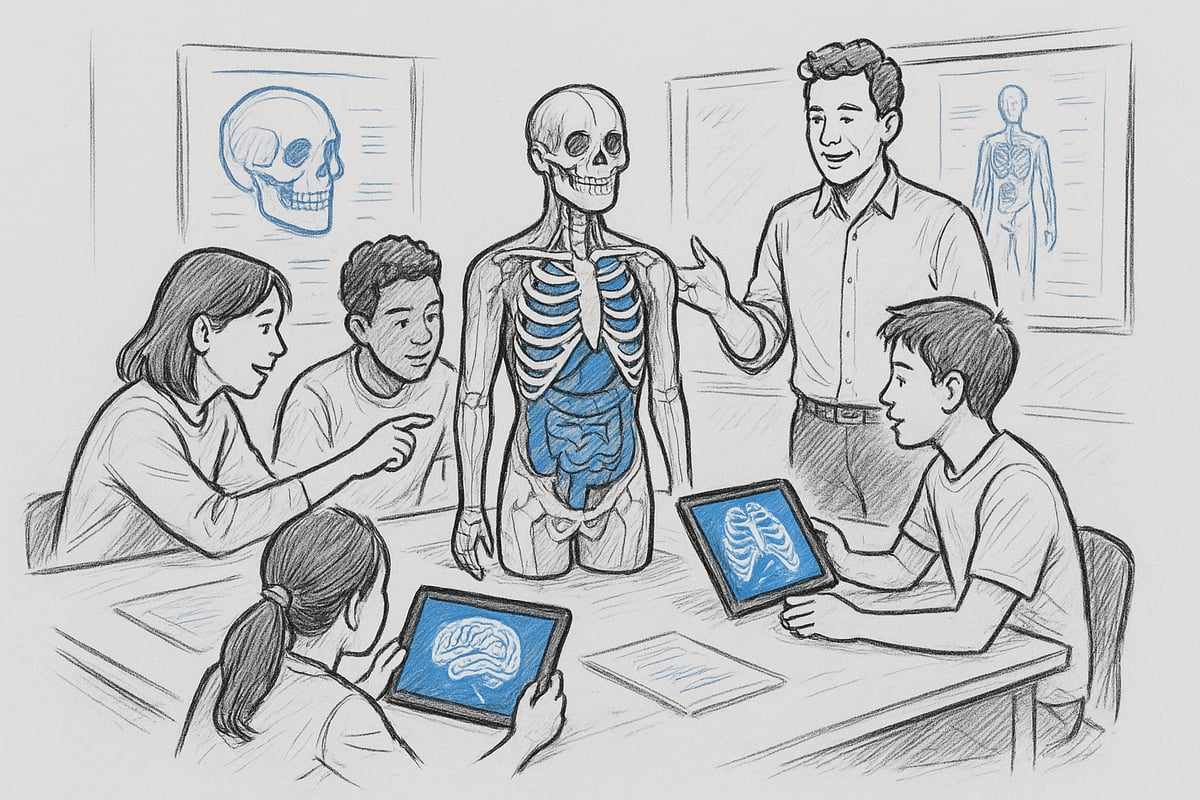
Active learning is a central principle in anatomy teaching. When students participate in hands-on activities, group work, and peer teaching, they gain a deeper understanding of the material. Role-playing and simulations are particularly effective because they engage both the head and the hands.
For example, a group of students could conduct a simulation of the circulatory system, with each participant representing a part of the body. This approach not only increases understanding, but also promotes long-term memory. Active learning makes it easier to translate theory into practice, which is essential for lasting knowledge.
Visualization and multimodal teaching
Visualization plays a crucial role in anatomy teaching. By combining posters, models, videos, and digital animations, educators can accommodate different learning preferences. Statistics show that multimodal teaching can increase understanding of complex topics by up to 25 percent.
A good example is the use of anatomy posters in teaching , where visual aids make difficult concepts more accessible. Multimodal methods also support differentiation so that all students get optimal benefit from the teaching.
Feedback and reflection as a learning engine
Constructive feedback and reflection are essential elements in anatomy teaching. When students are given the opportunity to receive ongoing feedback through quizzes and formative tests, both motivation and self-confidence are strengthened.
Self-reflection helps students identify their own strengths and challenges. For example, short quizzes can be a regular part of the teaching, making it easy to adjust the learning process. This approach ensures that learning becomes an active and dynamic process.
Differentiation and adaptation to student groups
Effective anatomical teaching requires that materials and methods be adapted to different student groups. This may mean using different models, cases, and assignments, depending on whether the teaching is at the elementary school or university level.
Inclusion of students with different backgrounds and learning styles is essential to ensure that everyone gets the full benefit. Differentiating instruction can create a learning environment where all students experience success and progression.
Digital and Interactive Learning Tools 2026
Digital and interactive learning tools are becoming increasingly important in anatomy education. These developments create new opportunities to engage students, increase learning outcomes, and make complex anatomical topics more accessible. The following is a review of six key areas that are shaping the future of digital anatomy education.
Virtual labs and simulation
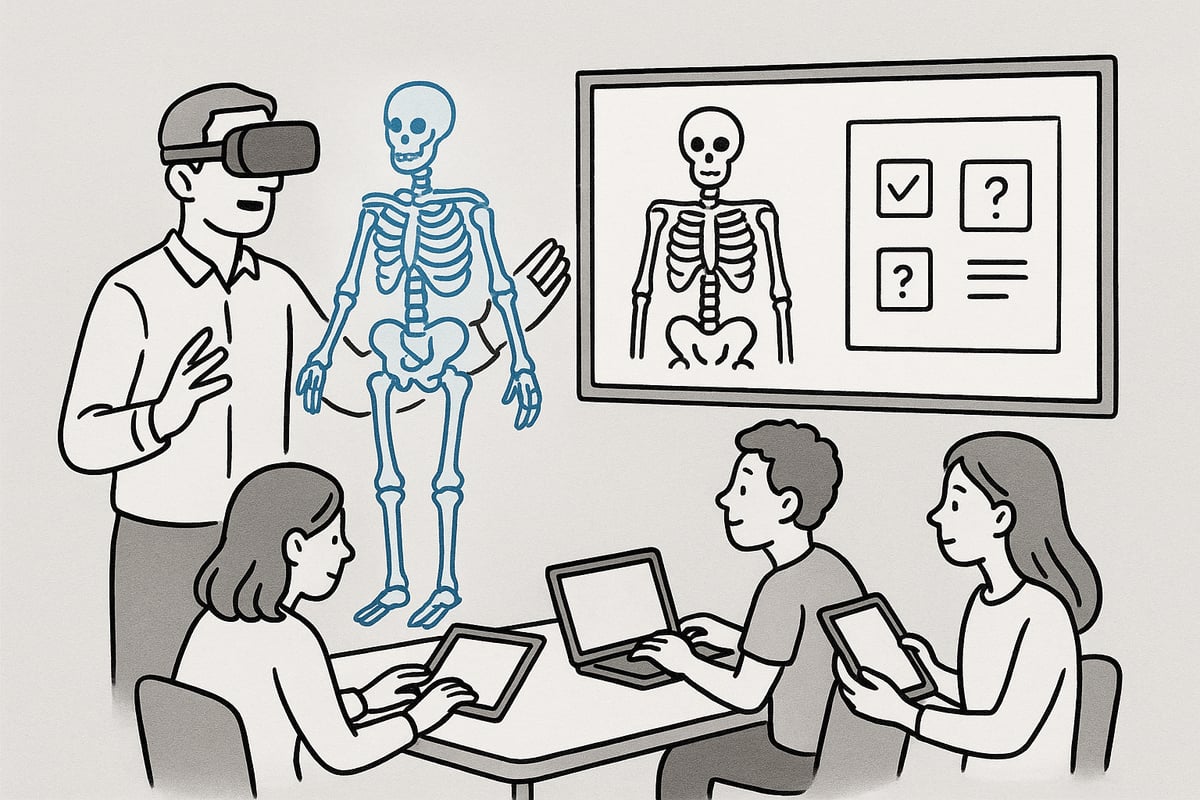
Virtual labs are revolutionizing anatomy education by providing access to advanced dissection and simulation without the need for physical cadavers. With 3D software, VR headsets, and interactive apps, students can experience body structures in detail and practice procedures repeatedly.
Studies show that virtual labs make teaching more accessible and flexible for students at all levels. For those who want more digital resources, Digital Learning Tools for Anatomy offers inspiration and tools for both educators and students.
This development makes it possible to tailor the learning experience and strengthens the understanding of complex relationships in anatomical teaching.
Online platforms and blended learning
Online platforms play a central role in modern anatomy education. E-learning systems (LMS) are used to organize materials, assignments, and discussions, providing both flexibility and structure.
Blended learning combines online learning with physical meetings. This allows students to learn at their own pace and repeat difficult topics. At the same time, the teacher can monitor their progress and adapt the content as needed.
The result is a more inclusive and dynamic teaching, where digital tools support both individual and collaborative learning in anatomical teaching.
Adaptive learning systems and AI
Adaptive learning systems, based on AI, are rapidly emerging in anatomy education. These platforms analyze the student's strengths and weaknesses and automatically adapt content and exercises to the current level.
For example, students can receive automated feedback on their answers and access supplementary materials if challenges arise. Statistics show that AI-based systems can reduce course dropouts by up to 15 percent.
This technology paves the way for a more personalized and effective learning journey in anatomy teaching.
Gamification and learning motivation
Gamification brings playful elements into anatomy teaching and increases student motivation. By integrating points, badges, and competitions, the learning process becomes more engaging.
Examples of gamification include quizzes, anatomically themed escape rooms, and digital games where students compete to solve cases as quickly as possible. These methods have been shown to increase both participation and retention.
The use of gamification creates a positive learning environment where students become more active in their own anatomical learning.
Digital collaboration and peer learning
Digital collaboration supports the development of collaborative skills and critical thinking in anatomy teaching. Online group work, discussion forums, and peer review allow students to share knowledge and perspectives.
Virtual study groups and shared projects promote dialogue and reflection. Students learn to work together to solve complex problems, which strengthens their understanding and prepares them for interdisciplinary collaboration in practice.
This approach contributes to an inclusive and dynamic learning environment in anatomy teaching.
Challenges and solutions in digital education
Although digital tools open up new opportunities for anatomy teaching, challenges also arise. Technological access, digital literacy, and maintaining interaction can be barriers for both students and teachers.
To address these challenges, many institutions are choosing hybrid models, offering technical support and investing in ongoing training. Examples from schools and universities show that targeted efforts can ensure success with digital solutions.
It is crucial that educators continuously adapt to developments to ensure the quality of anatomical teaching.
Hands-on Teaching: Anatomical Models and Practical Training
Understanding the complexity of the body requires more than just theory. Hands-on teaching allows students to explore and physically engage with the topics they are learning about. This section explores how physical models and hands-on training enhance anatomical teaching and prepare students for the demands of the future.
Advantages of physical anatomical models
Physical models are central to anatomy teaching because they allow students to sense, touch, and examine the structures of the body. Tactile learning enhances understanding of spatial relationships, which can be difficult to achieve through books or digital media alone.
Statistics show that students who work with hands-on models remember up to 40 percent more of the material. This type of teaching motivates and engages more types of students, especially those who need visual and physical interaction. Practical experience also strengthens students' self-confidence when they later encounter clinical situations.
Choice of models: From skeletons to specialized organs
The range of models for anatomical teaching is wide. There is everything from complete skeletons and skulls to detailed organ models and muscle groups. The choice depends on the level of teaching and learning objectives.
A good practice is to match the model to the student group. Elementary school students benefit from simple, robust models, while university students often work with more advanced and segmented variants. For inspiration on choosing and using models, delve into Hands-on Anatomical Models , which describes torso models in depth.
Integration of models into teaching courses
Effective anatomical teaching is based on structured integration of models into daily routines. Plan hands-on sessions where students work in groups and solve problems with the models. Combine physical work with digital tools to support theory and practice in parallel.
For example, a course may include role-playing where students identify organs or perform “mini-surgery” on models. This makes the learning more realistic and interdisciplinary, which increases the anchoring of the material. A varied approach ensures that all students benefit from anatomical teaching.
Maintenance and updating of teaching materials
To maintain high quality in anatomical teaching, it is important to continuously maintain and update the models. Worn parts should be replaced, and new technologies can be integrated to ensure that the materials match the latest teaching standards.
Quality control is crucial, especially when many students use the same models over time. Investing in durable and future-proof materials pays off, as it both increases learning outcomes and reduces costs in the long term. Updated models also support more innovative teaching practices.
eAnatomi ApS: Innovative Anatomical Models and Posters
eAnatomi ApS is a key player in anatomical education in Denmark. The company offers a wide range of models and posters, developed in close collaboration with healthcare experts. The range covers everything from human to animal anatomy, making it possible to adapt the education to different target groups and purposes.
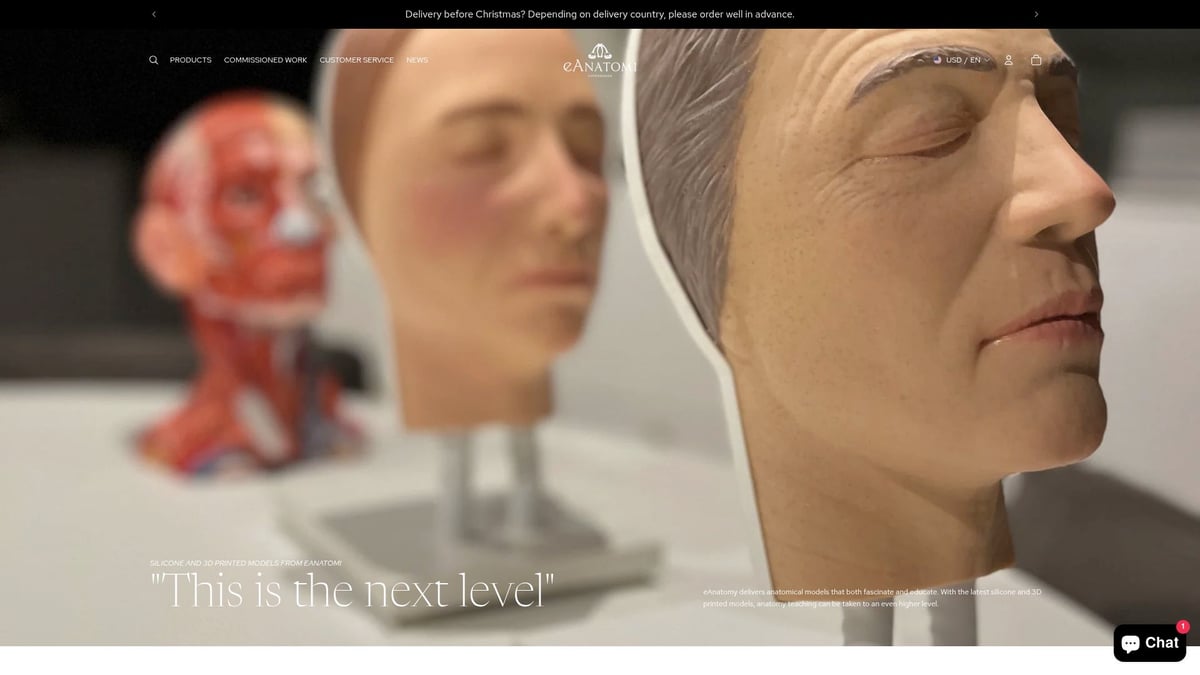
Focus on realism and safety has led to the development of formalin-free, infection-free 3D models and large, detailed posters. Schools and universities use eAnatomi's products to enhance the practical dimension of anatomical teaching. The company supplies both to educators, institutions and healthcare professionals nationally and internationally.
Evaluation and Documentation of Learning Outcomes
Effective assessment and documentation are essential for measuring learning outcomes in anatomy teaching. By combining different assessment methods, both teachers and students gain a clear picture of progression and understanding. Modern practice focuses not only on final tests, but also on ongoing feedback and digital documentation.
Formative and summative evaluation in anatomy teaching
In anatomy teaching, it is important to distinguish between formative and summative assessment. Formative assessment is ongoing and is used to support students' learning process. Examples include online quizzes after each lesson, practical tests with models, or oral presentations where students explain anatomical structures.
Summative assessment takes place at the end of a course of instruction and measures how much the student has learned. This may include major exams or projects. Formative assessment promotes learning as it progresses, while summative assessment documents overall achievement. A balanced use of both ensures that students are continually developing their understanding of anatomy.
Digital evaluation tools
Digital tools have revolutionized assessment in anatomy education. Automated tests, adaptive quizzes, and online peer assessment make it easier to track individual student progress. Multiple Choice Questions (MCQ) tests can provide quick feedback and identify areas where the student needs more practice.
Statistics show that digital assessment tools reduce the time teachers spend on assessment and significantly increase learning efficiency. Many teachers now use platforms that collect results, provide an overview and facilitate ongoing documentation. For inspiration on materials and digital tools, you can find didactic resources for teachers , which offer concrete tools for assessment.
Documentation of learning outcomes and progression
Systematic documentation of learning outcomes has become standard in anatomy teaching. Teachers use methods such as portfolios, learning diaries, and digital badges to make student progression visible. Portfolios collect student work over time and make it possible to follow development step by step.
Learning diaries promote reflection and help students identify their own strengths and weaknesses. Digital badges mark achieved competencies and can be shared across platforms. Documentation strengthens motivation as students can see their progress and the teacher gets a solid basis for individual guidance in anatomical teaching.
Quality assurance and accreditation
Quality assurance is central when it comes to anatomical teaching, especially in health education. National and international standards ensure comparability and high professionalism. Accreditation often requires that specific learning objectives and evaluation methods are met.
For example, both theoretical and practical exams are required at universities and in continuing education. Courses such as the Head, Neck and Musculoskeletal Course follow these requirements and offer structured evaluation of both knowledge and skills. Quality assurance ensures that students get the necessary benefit and that the teaching follows the latest standards.
Future Trends and Tendencies in Anatomical Teaching
The future of anatomy education is shaped by technological, didactic and ethical trends. We are already seeing how artificial intelligence, AR/VR, sustainability, interdisciplinary and lifelong learning are shaping teaching practices. To remain relevant and effective, both educators and institutions must stay abreast of these trends. The following sections provide an overview of the most central trends expected to shape anatomy education in 2026.
Artificial intelligence and personalized learning
Artificial intelligence (AI) is revolutionizing anatomy education by offering adaptive learning platforms that adapt to the level of each student. With AI, teaching content and progression can be automatically adjusted so that students receive targeted support exactly where they need it. For example, an AI system can suggest extra exercises or alternative explanations if a student is struggling with a topic. According to international analyses, the use of AI in education is expected to increase by 20 percent annually. This creates opportunities for more differentiated and effective anatomy education, where all students can get maximum benefit regardless of their starting point.
Augmented and virtual reality (AR/VR)
Augmented and virtual reality are becoming increasingly important in anatomy education. With AR and VR, students can experience immersive 3D environments where they interactively explore the structures of the body. Virtual dissections and visualization of complex anatomical relationships make it possible to learn in new ways that were not possible before. The advantage is that all students – regardless of access to physical cadavers – have equal opportunities for hands-on learning. This democratization of advanced anatomy education strengthens both understanding and motivation. AR/VR is expected to become an integral part of the curriculum at many educational levels.
Sustainability and ethics in educational materials
Ethics and sustainability in anatomical teaching have come into focus. Many institutions are moving away from traditional cadavers and towards formalin-free, synthetic models and digital simulations. These solutions reduce environmental impact and ensure ethically sound learning. New materials and technologies, as described in the Guide to Anatomical Models 2025 , make it possible to choose models that are both safe, hygienic and realistic. This means that anatomical teaching can increasingly be adapted to modern demands for sustainability without compromising the quality of learning.
Interdisciplinarity and collaboration in teaching
Interdisciplinarity will be a key word in the future of anatomy education. Integrating anatomy with physiology, biology and health education makes learning more relevant and practical. Projects across subjects and educational fields strengthen both collaboration skills and critical thinking in students. This approach better prepares them for a job market where interdisciplinary collaboration is the norm. By bringing together multiple disciplines, a more holistic picture of the body and its functions is obtained, which increases the benefit of anatomy education for all types of students.
Lifelong learning and continuing education
The need for continuous upskilling and continuing education is growing as anatomical education evolves. More educators and healthcare professionals are taking online courses, workshops and certifications to stay up to date with the latest methods. According to studies, 70 percent of educators expect to take continuing education in digital anatomy by 2026. Articles such as Continuing Education in Anatomy for Clinicians emphasize the importance of continuous learning and introduce new forms of education that match the demands of the future. Lifelong learning ensures that the quality of anatomical education remains high and up-to-date.
When we look at the future of anatomy education, it becomes clear how important it is to combine modern digital tools with hands-on models and engaging didactics. You will get the most benefit when you choose materials that not only convey knowledge, but also arouse curiosity and strengthen understanding. At eAnatomi you will find a wide selection of models and posters developed in close collaboration with experts, so you are assured of quality and relevance regardless of the level of education. If you want to delve further into the latest and most effective solutions for anatomy education, then Read more here
0 comments