Skull with masticatory muscles, 10 parts

Skull with masticatory muscles, 10 parts

1,935.00 kr
Sale price  1,935.00 kr Regular price 
Skip to product information
Skull with masticatory muscles, 10 parts
1/5

Skull with masticatory muscles, 10 parts

Artikelnummer: A166

Produktet er udgået af vores faste sortiment. Søger du specifikt dette produkt? Kontakt os for mere information.

The product is no longer part of the permanent assortment

If you are interested in this product, we would be happy to check if we can source it for you. Please contact us.
Description

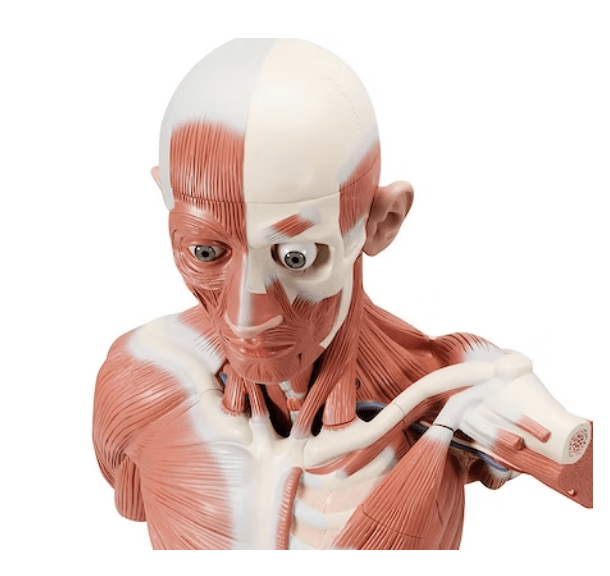
This skull model covers most needs, is produced in adult size and is sold at the lowest possible price. As a special feature, it also shows all the masticatory muscles, which can be removed.


As described for the other variants of the skull model (without or with the dural septa), it is cast in white plastic and is supplied in a size corresponding to an adult. The skull cap ("top") can be removed, so that, among other things, the base of the skull (basis cranii interna) can be studied. The skull cap is held in place by small magnets and plastic pins, which are only visible when it is removed. It should be mentioned that this joint all the way around appears with an uneven/ragged edge when the cap is mounted. This lack of finishing should be compared with the skull model's low price.

Anatomically speaking

Anatomically, it must be emphasized that this variant of the skull model offers a pedagogical opportunity to study the masticatory muscles and their attachments to the skull. The muscles are:


M. masseter
M. temporalis
Lateral pterygoid muscle
M. pterygoid medialis


The 4 masticatory muscles are represented on both sides of the skull model and can be completely disassembled (see pictures on the left).


As described in the other variants of the skull model, the human skull can be divided into 2 parts, and the skull model therefore shows the following:


1) The braincase (neurocranium), which is intended to enclose the brain and the hearing-equilibrium organ


2) The facial skeleton (viscerocranium) which surrounds the nasal cavity and forms the tooth-bearing framework around the oral cavity. The 32 teeth are also included


The braincase consists of 8 bones. There are 4 unpaired (the frontal, sphenoid, sphenoid and occipital bones) and 2 paired (the occipital and temporal bones). All these bones as well as sutures can be identified on the skull model.


The facial skeleton includes 6 paired bones (the maxilla, palatine, cheekbone, nasal bone, lacrimal bone, and lower conchbone) and 3 unpaired bones called the mandible, the ploughshare, and the zygomatic bone (some do not count the zygomatic bone as part of the facial skeleton). All these bones and sutures can also be identified on the skull model. NB: The hyoid bone is also included in the facial skeleton but cannot be seen on this skull model.


The human skull contains many holes and channels containing vessels and nerves. Overall, there are connections between the braincase and the neck, to and from the eye socket, to and from the pterygo-palatine fossa and to and from the nasal cavity.


This skull model shows many of the most important holes and canals, but not all. Furthermore, the level of detail on the bones is good. As for "osseous landmarks" such as the processus styloideus, many of the most important are seen, while some minor participants are omitted.

Movement-wise

In terms of movement, it is only relevant to mention the jaw joint. The lower jaw bone ("mandible") is held in place via a relatively long metal spring, which is attached via screws to the mandible and palatine bone. In addition, large pieces of rubber are mounted in the joint bowls (fossa mandibularis) of the jaw joints, which hold the joint head (caput mandibulae) "like in a rubber bowl" (see the pictures on the left).


The model's jaw joints are not very flexible. Natural movements in the jaw joint require that, among other things, the articular head can slide forward and downward until the articular head is forward on the tuberculum articulare. The latter is the bony part with a weak guiding groove in front of the depression (fossa mandibularis). This can only be demonstrated on the model if the rubber in the joint cups is removed, which the model is not designed for.


If you take a firm hold of the mandible, you can however move it up and down and to the sides, although the natural sliding joint mechanism as described above cannot be demonstrated at all.


The mandible can be completely removed, but it requires at least one screw to be removed with a screwdriver.

Clinically speaking

Clinically, the skull model can be used to understand diseases and disorders in the jaw joint and masticatory muscles, such as jaw tension and temporomandibular dysfunction (TMD).


The model is also ideal for understanding other diseases, disorders and disorders in this part of the skeleton.

Contact us

Our anatomical product range
Raffle for free products

All recipients of our newsletter are entered into raffles for free products. Sign up today and be in the running!