

Imagine a classroom where anatomy teaching sparks curiosity and engagement in every student. Here, the desire to learn is evident and students actively participate in the lesson.
With this guide, you will get concrete tools on how to create an exciting learning environment for anatomy teaching in 2026. You will gain insight into pedagogical strategies, innovative learning materials, use of technology, physical layout, and methods to strengthen motivation and collaboration.
Get inspired by modern solutions and discover how you can transform your teaching with effective and engaging approaches. Take the first steps towards creating a learning environment where anatomy becomes alive and relevant for all students.
Understanding Students' Learning Needs and Motivation
Understanding students' different needs and motivations is the foundation for how you work with this to create an engaging learning environment for anatomy teaching. Each class consists of individuals with unique preferences, experiences, and challenges. Therefore, it is essential to investigate how the learning environment can be adapted so that all students have optimal conditions to learn anatomy effectively and engaged.
Identify different learning styles in anatomy teaching
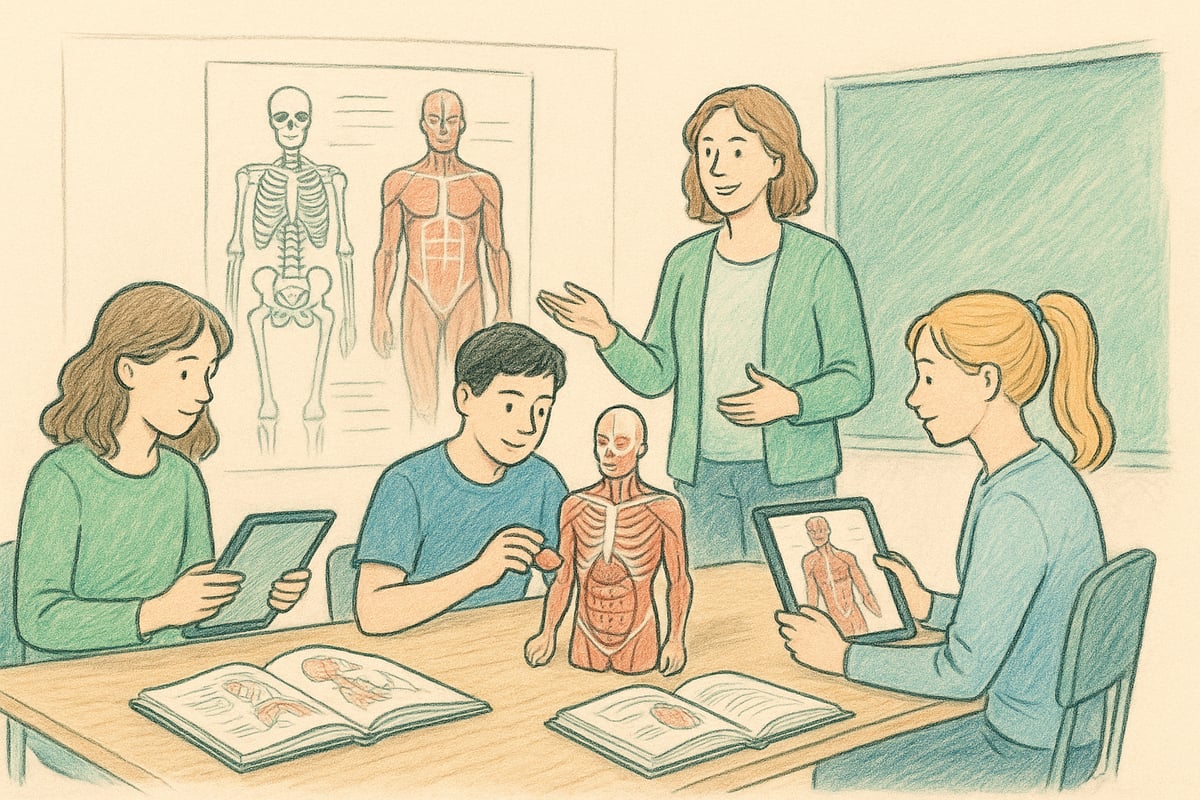
Learners acquire knowledge in many ways. Some learn best visually through diagrams and models, while others prefer to listen to explanations or engage through practical exercises. Kinesthetic learners benefit from hands-on activities such as assembling skeleton parts, while read/write preferences place a high value on notes and textual material.
By integrating multiple learning styles into your teaching, you can create an engaging learning environment for anatomy teaching. For example, a lesson on circulatory systems can be combined with anatomy posters, podcasts, and interactive quizzes. This variety ensures that all students have the opportunity to engage on their own terms.
The role of motivation in anatomy learning
Motivation is a crucial factor in the success of anatomy lessons. Students with high motivation perform up to 30% better, according to Education Corner. Intrinsic motivation, such as curiosity and interest in the subject, often has a greater impact than extrinsic motivation, such as grades.
To support motivation, you can draw on resources such as the Anatomy Student Guide , which offers concrete tips for making anatomy more relevant and inspiring. When students experience the material as meaningful, it strengthens them, creating an exciting learning environment for anatomy teaching.
Challenges students often face
Anatomy is a demanding subject. Many students struggle with its complexity, especially when it comes to memorizing Latin terms and understanding abstract concepts. According to BMC Medical Education, 60% of medical students feel overwhelmed by the challenges of anatomy.
To address these barriers, it is important to break the material down into smaller, manageable chunks. Using visual aids, repetition, and practice-based activities can make it easier to navigate the material. This is how you create an engaging learning environment for anatomy teaching where students dare to ask questions and experiment.
The importance of a safe and inclusive environment
A safe and inclusive learning environment promotes both well-being and learning. Differentiated teaching, where tasks and approaches are adapted to the student's level, ensures that no one feels lost. Open discussions and respect for different perspectives strengthen unity in the class.
When students feel their input is valued, their engagement increases. Here's how to create an engaging learning environment for anatomy teaching by prioritizing inclusion and community.
Feedback and ongoing evaluation
Feedback is essential in anatomy teaching. Formative feedback, provided continuously through dialogue and assignments, helps students adjust their understanding along the way. Summative feedback, typically in the form of grades, provides a picture of overall achievement.
Practical methods can include short quizzes, peer feedback, or reflection tasks. By integrating clear and constructive feedback into your teaching, you support and create an engaging learning environment for anatomy teaching where students feel seen and guided.
Perspectives from teachers and students
Educators often emphasize the importance of engagement and interaction: “When students are allowed to explore and discuss, their understanding grows significantly.” Students report that interactive learning environments make teaching both more fun and more rewarding.
By incorporating both the teacher's and students' experiences, you can continuously optimize how you create an exciting learning environment for anatomy teaching. Focusing on dialogue and collaboration paves the way for a more vibrant and inclusive teaching.
Innovative Learning Tools and Teaching Materials
The key to creating an engaging learning environment for anatomy teaching is to utilize innovative learning tools that engage and motivate students at all levels. The choice of materials has a major impact on both understanding and retention of knowledge. Modern technology and classic tools can combine to create a dynamic learning space.
Modern teaching materials for anatomy
Today, there are a wealth of modern teaching materials that make it easier to create an exciting learning environment for anatomy teaching. 3D models of organs and skeletons allow students to examine structures from all angles. Large, detailed posters help visualize complex relationships.
Digital apps and VR/AR solutions open up interactive experiences where students can explore the body virtually. Statistics show that 75% of teachers experience increased student engagement when they use interactive models. This makes learning more relevant and exciting, regardless of whether the teaching takes place in primary school, high school or higher education.
Benefits of tactile and visual aids
Tactile and visual aids significantly enhance understanding and contribute to creating an exciting learning environment for anatomy teaching. When students are allowed to work hands-on with models, abstract concepts become more concrete.
For example, comparisons show that learning outcomes increase when students use physical models rather than just reading or listening. Visual aids such as posters also provide an overview that facilitates memorization and repetition. The combination of multiple senses promotes both motivation and long-term memory.
Selection of materials for different levels
It is important to choose materials that match the students' age and abilities to ensure you create an exciting learning environment for anatomy teaching. In primary school, colorful posters and simple 3D models can arouse curiosity.
In high school and higher education, there is a need for more detailed models and digital platforms that can show microscopic structures and advanced relationships. Adapting materials ensures that all students receive a benefit that matches their learning level.
eAnatomy: Innovative Anatomical Models and Posters
When working with such a way as to create an exciting learning environment for anatomy teaching, it is important to choose suppliers who focus on quality and pedagogy. eAnatomi ApS offers realistic, ethical and sustainable anatomical models and posters developed in collaboration with healthcare experts.
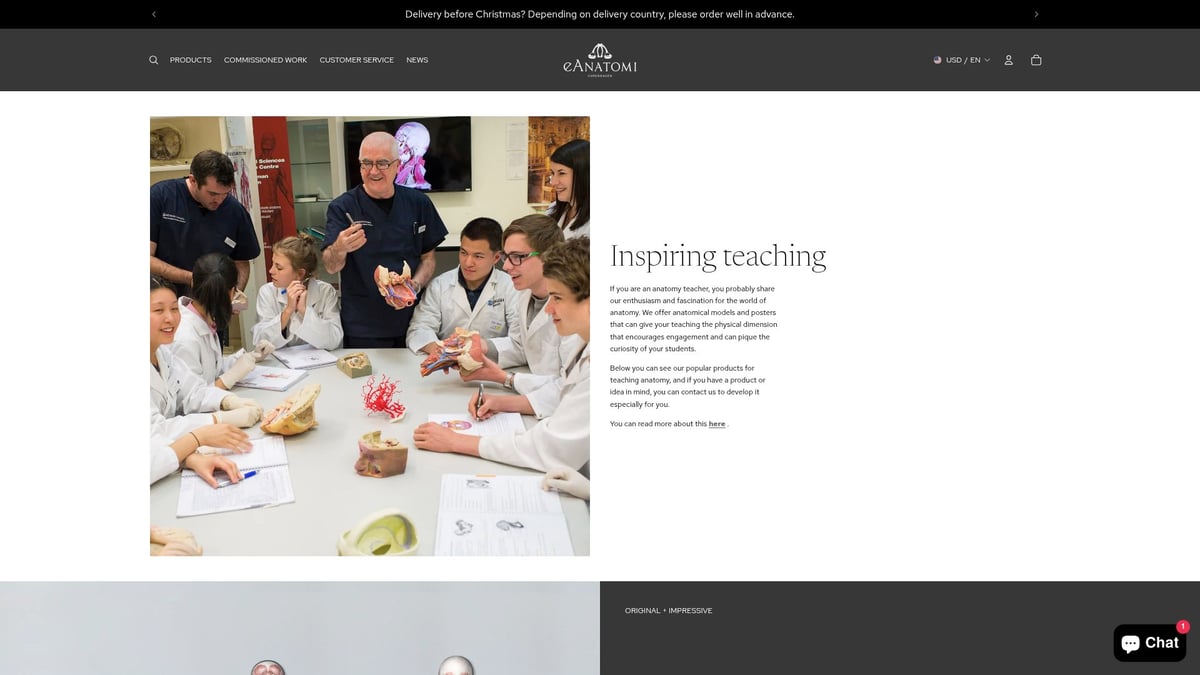
The products are used in both primary schools and universities, where they support the academic goals of teaching. At Anatomical models and posters in teaching you can find inspiration and resources for integrating models and posters into your teaching and experience concrete examples of their use in practice.
Integration of digital and analog resources
An effective strategy for creating an engaging learning environment for anatomy teaching is to combine digital and analog resources. Physical models allow students to feel and see structures, while digital platforms offer flexible access to quizzes, videos, and simulations.
This combination allows for different learning styles to be accommodated and creates variety in the teaching. It promotes both understanding and motivation as students can switch between practical and theoretical activities.
Case: School that has improved the learning environment with new materials
A Danish school wanted to improve how to create an engaging learning environment for anatomy teaching and invested in both 3D models, posters and digital tools. Before implementation, teachers experienced that many students had difficulty understanding and remembering the anatomical concepts.
After the integration of the new tools, engagement increased significantly. Students participated more actively, asked more questions, and showed greater interest in the subject. Evaluation showed that both learning outcomes and motivation improved significantly.
The Role of Technology in the Future of Anatomy Teaching
Technology is rapidly changing the way we teach anatomy. Digital tools are opening up new ways to engage students and creating learning environments that are both dynamic and effective. That is why it is important to understand how technology can support and enhance this, so you can create an engaging learning environment for anatomy teaching.
Digital platforms and e-learning
Digital platforms have become a cornerstone of modern anatomy education. Teachers use online learning systems, interactive quizzes, and video lessons to make the material more accessible. A study from Statista shows that 80% of students use digital resources daily in their studies. This helps to create an engaging learning environment for anatomy education, where students can learn at their own pace and repeat difficult concepts.
Digital platforms also enable access to updated material and easy sharing of resources. At the same time, the teacher can monitor student progress and adapt content as needed.
Virtual Reality (VR) and Augmented Reality (AR)
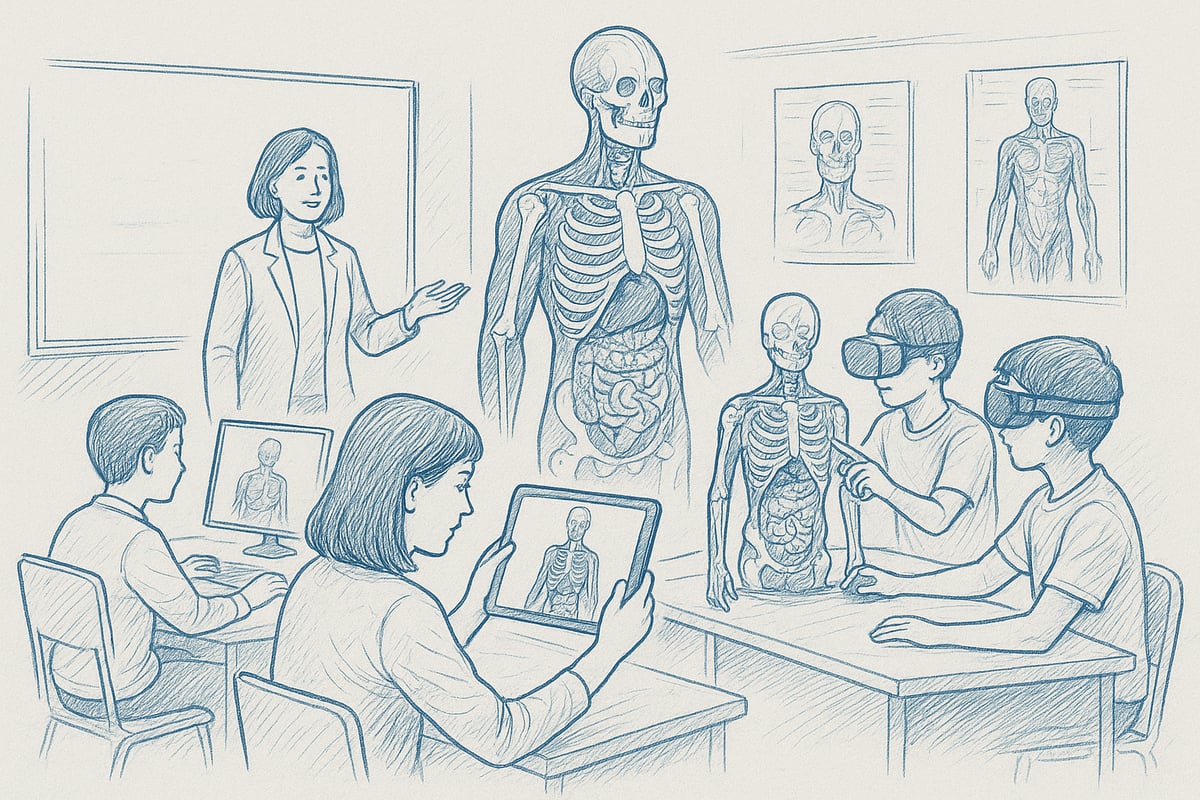
VR and AR have revolutionized the understanding of complex anatomical structures. With 3D visualization, it is possible to “explore” the human body in a way that traditional books cannot match. For example, VR dissections can give students an experience reminiscent of the real world, but without the ethical and logistical challenges.
A quantitative study has compared the learning outcomes between virtual 3D simulation and traditional anatomy teaching among radiography students, with the results indicating a significant improvement in engagement and understanding. Read more about Virtual 3D Simulation in Anatomy . VR and AR make it easier to implement this way you create an exciting learning environment for anatomy teaching, where students can experiment and visualize abstract concepts.
Apps and interactive tools
The range of anatomy teaching apps is growing rapidly. Some apps use gamification, where students earn points and badges for correctly answering questions or completing exercises. This increases motivation and makes teaching more fun.
By integrating apps and interactive tools, teachers can easily vary their teaching and adapt activities to different learning styles, supporting an engaging learning environment for anatomy teaching and ensuring that all students have the opportunity to engage.
Data and adaptive learning
AI-based systems are starting to play a central role in anatomy teaching. These systems analyze student responses and automatically adjust difficulty and topic selection, providing students with tailored feedback that promotes individual progression.
Adaptive learning makes it easier to accommodate different levels in the class. This helps create an engaging learning environment for anatomy teaching where everyone can succeed, regardless of their starting point.
Challenges and solutions in technology integration
Although technology offers many benefits, challenges can arise. Availability of equipment, technical support and teacher qualifications are key aspects that need to be addressed. Not all students have access to the latest technology at home, and this can create inequality.
Possible solutions include investing in school equipment, training teachers, and establishing technical support. Addressing these challenges can ensure that creating an engaging learning environment for anatomy education is accessible to all.
Future perspectives for technology in anatomy education
Towards 2026, technological innovations are expected to continue to shape anatomy education. Developments in VR, AR and AI will make teaching even more interactive and personalized. New digital platforms will support collaboration across disciplines and national borders.
In summary, technology will continue to be a central driving force for how you create an exciting learning environment for anatomy teaching, where both students and teachers have optimal conditions for learning and development.
Physical Design and Atmosphere in the Learning Environment
A well-designed physical learning environment is fundamental when you ask yourself, how do you create an exciting learning environment for anatomy teaching? The layout of the room affects both concentration, motivation and collaboration. Modern research shows that ergonomic furniture, comfortable lighting and good acoustics create optimal conditions for learning. According to the Danish Building Research Institute, good lighting can increase concentration by up to 20 percent. Therefore, the choice of furniture and colors should not be underestimated, as it can make a significant difference to student engagement.
Placement and display of teaching materials
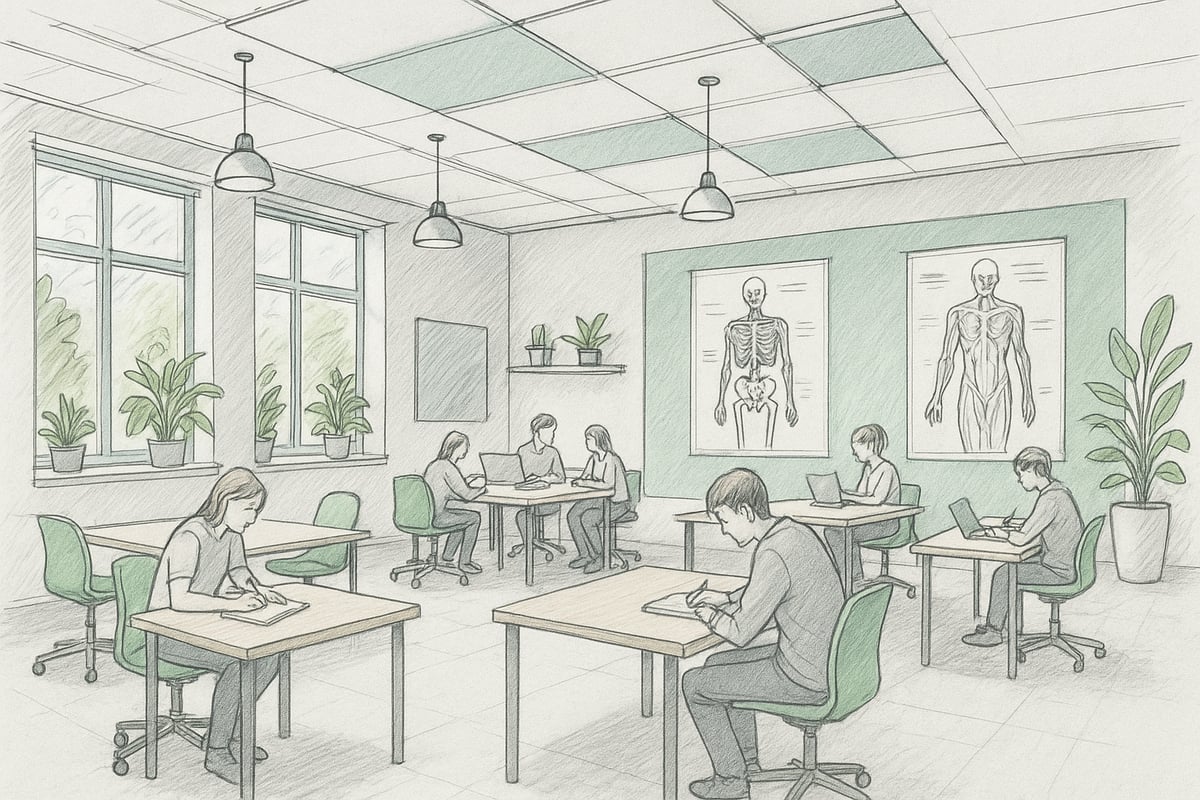
When working with the question of how to create an engaging learning environment for anatomy teaching, the placement of teaching materials is key. Anatomical models, posters and digital screens should be placed visibly and easily accessible to all students. Large posters and colorful visual aids can make complex topics more understandable and motivating. If you want inspiration on how visual aids can be used actively, you can read more about ideas for decorating anatomy rooms , where the use of large-format posters is highlighted as an effective method of engaging students.
Create an inspiring and safe atmosphere
A safe and inspiring environment is essential if you want to know how to create an exciting learning environment for anatomy teaching. Themed walls, green plants and visual stimuli can make the room more inviting and create calm. Using colors, such as blue or green, can support concentration and reduce stress. In addition, open, bright spaces with room for movement have a positive impact on students' well-being and desire to participate actively in the lesson.
Flexible learning zones and examples
Flexible learning zones are a key element when investigating how to create an engaging learning environment for anatomy teaching. The layout should accommodate areas for group work, individual immersion and practical exercises. A well-designed room can quickly be transformed from classroom teaching to hands-on activities. For example, several Danish educational institutions have created zones with movable tables and specially designed stations for anatomy exercises, which has increased both collaboration and engagement.
Practical tips for optimizing the classroom
Finally, there are a number of low-tech measures that can make a big difference to creating an engaging learning environment for anatomy teaching. Small changes such as adding extra light sources, using acoustic panels, or hanging posters at eye level can improve both the atmosphere and learning. Also consider involving students in the design, so that they feel ownership and responsibility for their learning space. Even minor adjustments can create a space where curiosity and learning flourish.
Pedagogical Strategies and Activating Teaching Methods
Differentiated teaching of anatomy
Differentiated teaching is a key element when asking how to create an engaging learning environment for anatomy teaching. Students come with different backgrounds, learning styles, and experiences, which requires flexible approaches from the teacher.
It is important to vary the tasks, pace and difficulty so that all students are challenged at their level. For example, some students may benefit from visual resources such as posters, while others prefer hands-on activities. By adapting the teaching, both motivation and learning outcomes are strengthened.
Planning and ongoing evaluation are essential for differentiation to be successful. Students experience being seen and are given the opportunity to actively engage in the material.
Activating learning methods
Activating learning methods are fundamental if you want to know how to create an exciting learning environment for anatomy teaching. Methods such as case-based learning, role-playing, and simulations make the material come alive and relevant.
Research shows that active learning can increase knowledge retention by up to 60% compared to traditional teaching. Simulations using Augmented Reality allow students to experience complex anatomical relationships in a new way. Read more about AR technology in nursing education and get inspiration for visual learning tools.
By incorporating different activating methods, you can motivate multiple student groups and strengthen their understanding of anatomy.
Interdisciplinary collaboration
Interdisciplinary collaboration is an effective strategy when it comes to creating an exciting learning environment for anatomy teaching. By integrating anatomy with subjects such as biology, physical education or health subjects, new perspectives and increased relevance emerge.
For example, anatomy lessons can be combined with physical exercises, where students gain a practical understanding of muscles and joints in motion. This not only promotes understanding, but also the joy of learning.
Collaboration across subjects also strengthens students' ability to see connections and apply their knowledge in multiple contexts.
Peer learning and collaboration between students
Peer learning and collaboration between students are essential when working on creating an engaging learning environment for anatomy teaching. Through group work, discussions, and collaborative problem-solving, students can learn from each other.
When students explain concepts to each other, their own understanding is strengthened. At the same time, a community is built where it is safe to ask questions and make mistakes. This creates an inclusive and motivating learning environment.
The teacher can support peer learning by facilitating small groups and providing a clear framework for collaboration.
Practical exercises and hands-on activities
Practical exercises and hands-on activities are essential to creating an engaging learning environment for anatomy teaching. Physical models, dissections, and digital tools allow students to experience anatomy in practice.
The use of visual aids such as posters can enhance understanding, especially when combined with hands-on activities. You can read more about how posters support an engaging learning environment in the article Benefits of Anatomy Posters .
The combination of theory and practice makes learning more relevant and significantly increases student engagement.
Ongoing evaluation and reflection
Ongoing evaluation and reflection are important elements in creating an engaging learning environment for anatomy teaching. Formative evaluation, where students receive feedback along the way, strengthens their learning process.
Reflection on one's own progress helps students identify strengths and areas for improvement. This can be done through short quizzes, feedback from the teacher, or by discussing solutions in groups.
A culture of open dialogue about learning creates security and promotes development.
The teacher's role as facilitator
The role of the teacher changes from being the primary communicator to acting as a facilitator when the focus is on creating an exciting learning environment for anatomy teaching. It's about guiding students and asking the right questions so that they can discover connections for themselves.
A facilitator supports students' curiosity and helps them take responsibility for their own learning. This can be done through open discussions, support for group work, and by creating an environment where mistakes are seen as a natural part of the learning process.
A committed teacher who takes the role of facilitator seriously can make a significant difference to both motivation and learning outcomes.
Create Engagement and a Sustained Desire for Learning
Creating engagement and a sustained desire to learn is key when you want to know, this is how you create an exciting learning environment for anatomy teaching. Curiosity is sparked when students encounter fascinating stories, real-life cases, and current examples that bring anatomy to life. Use storytelling to connect complex concepts with everyday experiences. For example, you could introduce a theme about “Mysteries of the Body” and let students explore how the body reacts in extreme situations. This not only sparks interest, but also strengthens long-term memory. Data shows that enjoyable learning can increase long-term memory by up to 50% (source: Learning Scientists).
Gamification and reward systems are effective tools when considering how to create an engaging learning environment for anatomy teaching. Points, badges, and competitions can add a fun and motivating element to the lesson. Let students earn points for correctly answering quizzes, collaborating, or creative presentations. Digital platforms and VR technology provide opportunities to integrate gamification into anatomy teaching. For example, the use of VR in rehabilitation and learning has shown that students become more engaged when they can interact with 3D models and virtual environments. This approach strengthens both motivation and learning outcomes.
Involving students in planning and evaluation is a key factor in creating an engaging learning environment for anatomy teaching. When students are given a say in the choice of topics, working methods and feedback, their engagement increases significantly. Create space for open discussions and reflection on how anatomy teaching can be improved. It is also important to focus on relevance and applicability. Explain how anatomy relates to real-life situations, such as sports injuries or illnesses. This increases students' understanding of why the subject is important to themselves and society.
Celebrate progress and successes regularly when working with, creating an exciting learning environment for anatomy teaching. Recognize both individual and collective achievements, for example through small ceremonies, exhibitions or diplomas. Motivating activities such as workshops, quizzes and exhibitions can make learning more enjoyable. A concrete example is the digitization of anatomical specimens, as described in Digital Skulls in Anatomy Teaching , where students have easier access to materials and thus experience greater motivation. By combining these strategies, you create an environment where desire for learning and engagement become a natural part of anatomy teaching.
As we explore how to create an engaging learning environment for anatomy teaching, it becomes clear how much the right materials and innovative methods matter. You have now gained insight into everything from motivation and learning styles to the use of both physical models and digital resources that can give your students a deeper understanding and a sustained desire to learn. If you want to delve even further into the possibilities of inspiring and enhancing your anatomy teaching with quality models and posters, you can Read more here .
0 comments