

Discover why a spine model is an indispensable tool for educators, healthcare professionals and anyone interested in anatomy. This guide gives you the complete overview of spine models in 2025. You will gain insight into model types, applications, selection criteria, price levels, leading manufacturers and the most important updates for the coming year. Spine models are more relevant than ever, both for learning and practical training. Read on and learn about the latest features, how to choose the right one and avoid common mistakes. Use this guide to make the best choice.
What is a spine model?
A spine model is a key tool used to illustrate and understand the structure and function of the spine. Whether you are a student, teacher or healthcare professional, a spine model gives you concrete insight into the body's complex structure. The models make it easier to visualize both normal conditions and disease states.

Definition and basic anatomy
A spine model depicts the anatomy of the spine, focusing on vertebrae, discs, nerves, and ligaments. Most models show the entire spine from the cervical vertebrae to the coccyx, while some only illustrate selected segments.
There are several variants:
- Full-scale spine model: Lifelike size, shows all anatomical details.
- Miniatures: Smaller models, easy to transport and store.
- Segmental models: Shows individual parts, e.g. lower back or neck.
A spine model is often used in schools, clinics and research environments. It differs from other anatomical models, such as torsos, by focusing specifically on the structure of the spine. Over 80% of Danish health education programs use spine models in teaching, which emphasizes the importance of the model. Read more about how students work with models in teaching at For students in anatomy .
Historical development and purpose
The development of the spinal column model began with simple wooden versions, which were later replaced by more accurate plastic models and now advanced 3D-printed versions. The purpose has always been the same: to make the structure and function of the spinal column understandable.
Spinal models have contributed significantly to the understanding of spinal diseases and treatment options. Today, they are used both to explain diagnoses to patients and to train healthcare professionals. For example, a doctor can demonstrate a herniated disc or explain how a particular treatment works using a detailed spinal model.
Types of spine models on the market
The market for spine models is broad. You can choose between:
- Flexible models : Can be bent to show movements and misalignments.
- Rigid models : Fixed shape, suitable for demonstrating structures.
- Color-coded models : With clear markings of nerves and blood vessels.
- Removable parts : Allows for the study of individual components.
- Special variants : Child models, adult models and models with pathological conditions.
For example: A 45 cm teaching model is ideal for classroom teaching, while an 80 cm full-scale model is best suited for hospital use. The choice depends on the need for detail and the area of application.
Areas of application
Spinal models are widely used in education, patient information, physiotherapy and research. In anatomy teaching, the models make it easier to explain body movements and common spinal disorders. In hospitals and clinics, they support patient education and dialogue about treatment options.
Physiotherapists often use spine models to illustrate exercises and rehabilitation. In research environments, they are used for product development and analysis of biomechanical conditions. Statistics show that 60% of physiotherapists actively use the spine model in patient guidance, which confirms its practical importance.
How to choose the right spine model in 2025
Choosing the right spine model requires you to consider several aspects to get the model that best matches your needs. Below, we guide you through the key steps, selection criteria, and practical considerations so you can make an informed choice in 2025.

Identify your need: Teaching, clinic or private use
Before investing in a spine model, it is crucial to clarify the purpose for which the model will be used. Teachers and educators often need models that can demonstrate movements and anatomical details clearly to larger groups. Students prefer flexible models that can be handled and examined up close.
Healthcare professionals, such as physiotherapists and doctors, focus on models that can be used in patient communication and training. Models with removable parts and color-coded nerves are often an advantage here. For private use, many choose smaller or simplified models that are easy to store and understand.
Consider how often and in what situations your spine model will be used. Should it be portable or should it be fixed in a classroom? For educators, it may be valuable to read more about how spine models are used in practice at For educators and teachers . Defining your needs precisely ensures that you choose the most relevant spine model.
Important selection criteria
Once you have determined your needs, you should focus on the most important selection criteria for your spine model. The material is key. Models are typically made of plastic, rubber or via 3D printing, which affects both durability and weight.
Ranging in size from compact 45cm models to full-scale versions that match the human anatomy, anatomical accuracy and level of detail are essential, especially in teaching and clinical settings where correct representation of vertebrae, discs and nerves is essential.
Easy cleaning and maintenance extends the life of the model and ensures hygiene. The price level ranges from budget-friendly models to advanced solutions, so it is important to balance quality against economy when choosing your spine model.
Features and extras
Additional features can make a spine model much more useful. Many models have color-coded nerves, blood vessels, and ligaments, making it easier to understand complex anatomical relationships. Consider whether you need an included stand or wall-mounting option so that the model can be optimally positioned.
Removable parts make it easy to demonstrate specific areas or pathologies. Some models come with accessories such as posters, exercise cards or digital apps that expand learning opportunities. For educators and students, the integration of digital resources alongside the physical spine model can significantly increase learning outcomes.
Comparison of popular models in 2025
The market for spine models has never been wider than in 2025. New best-selling models offer improved flexibility, higher levels of detail, and more customization options. For example, highly flexible models allow for the demonstration of natural movements, while standard models are often more robust.
The table below gives you a quick overview of typical models:
| Model type | Flexibility | Details | Price (approx.) |
|---|---|---|---|
| 45 cm teaching model | Low | Good | 300-500 kr. |
| 80 cm full scale model | High | Very | 1,200-2,500 kr. |
| Miniature model | Low | Basis | 200-400 kr. |
When choosing a spine model, you should evaluate the advantages and disadvantages of each type based on your specific needs and budget.
Buying Guide: What should you pay attention to?
Before purchasing a spine model, you should make sure that the model has relevant certifications and quality marks. This guarantees that the materials and construction meet applicable standards. Check the warranty terms and what customer service the manufacturer or retailer offers.
Delivery times and return policies may vary, so please read the terms carefully. Be aware that cheaper models often have limited durability and less anatomical accuracy. Consider investing a little more to ensure your spine model meets your requirements and lasts for many years.
Market-leading manufacturers and distributors
The spine model market has developed significantly in recent years, both internationally and in Denmark. Quality, innovation and user-friendliness have become key competitive parameters. Today, educational institutions, clinics and private individuals can choose from a wide range of models from recognized manufacturers and retailers. Here you will get an overview of the most important players and what you should pay attention to when investing in a spine model.
International and Danish producers
The range of spine models ranges from global giants to specialized Danish companies. Internationally, 3B Scientific and Erler-Zimmer are among the leaders, known for their high quality and innovative approach. These manufacturers offer a wide range, from simple teaching models to advanced 3D printed variants.
In Denmark, several companies have established themselves as experts in spinal models. Danish manufacturers often focus on sustainability, precision and collaboration with healthcare experts. This ensures models that meet both professional and environmental requirements.
Manufacturers are continually developing new materials and technologies to ensure that spine models meet the latest needs in education and clinical practice. Many also offer customized solutions for special purposes.
Comparison table: Selected manufacturers
| Producer | Country | Known for | Innovation |
|---|---|---|---|
| 3B Scientific | Germany | High precision | 3D printing, AR |
| Erler-Zimmer | Germany | Wide selection | Pathology. |
| eAnatomy ApS | Denmark | Expert knowledge, collaboration | Hybrid solutions |
Dealer overview and price comparison
When buying a spine model, it is important to choose an authorized dealer. Among the most popular in Denmark are Swemed, CDON and specialized webshops. They offer different price levels, depending on the model type, level of detail and accessories.
The price range for a spine model is typically between DKK 300 and DKK 2,500. Standard models for teaching are often found at the low end, while advanced or pathology-specific models cost more. Delivery times vary, but most retailers offer fast shipping and good customer service.
The advantage of shopping at authorized retailers is access to a warranty, the possibility of returns and the assurance of genuine quality products. Many retailers also offer advice so that you choose the right spine model for your needs.
Checklist when choosing a dealer:
- Authorization and certification
- Clear information about delivery and returns
- Customer reviews and support
eAnatomi ApS: Danish expertise in anatomical models
eAnatomi ApS is one of Denmark's most recognized suppliers of spine models and other anatomical equipment. The company develops original models in close collaboration with healthcare experts, ensuring high anatomical accuracy and relevance for both teaching and clinical use.
The range ranges from classic standard models to advanced spine models with pathology and special functions. eAnatomi also offers unique combination solutions, where spine models are supplemented with posters and digital resources for interactive learning.
The company delivers globally to both private and commercial customers, and emphasizes quality, innovation and ease of use. Read more about the background and expertise at About eAnatomy and expertise to gain insight into their approach to spine model development.
Customer reviews and experiences
Customer satisfaction is crucial when choosing a spine model. Educators, students and clinicians often evaluate models based on durability, ease of use and level of detail. According to surveys, leading retailers in Denmark score an average of 4.8 out of 5 on customer satisfaction.
Important parameters for a good experience with a spine model include:
- Robustness and resistance to wear
- Easy to understand assembly instructions
- Efficient customer service and support
Experience shows that investing in a quality model pays off in the long run. Users particularly highlight the difference it makes when the model is accurate and easy to use in both teaching and patient guidance.
Practical use of spine models: Step-by-step guide
Getting the most out of a spine model requires proper handling from start to finish. Here is a step-by-step guide to ensure your spine model is used optimally, whether you are a teacher, student or healthcare professional.
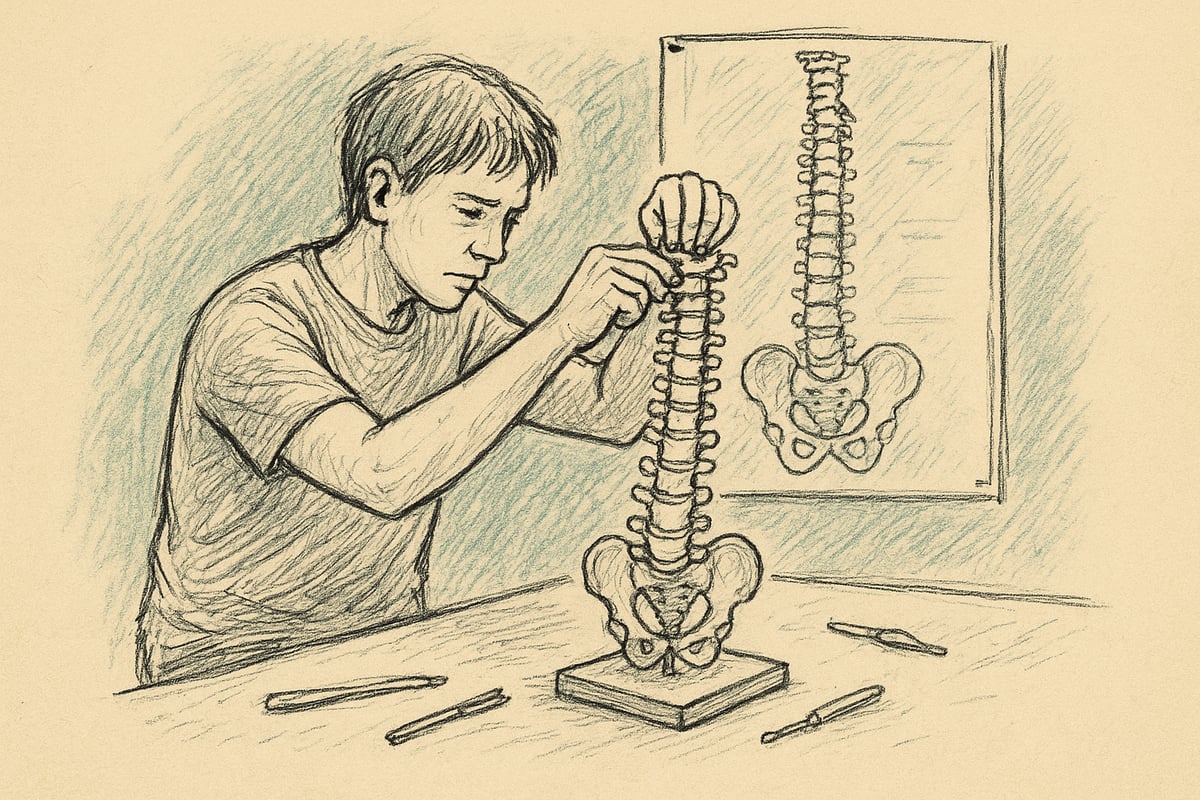
Step 1: Unpacking and assembly
When you receive your spine model, it is important to first check that all parts are intact and included. Check that vertebrae, nerves and any removable parts are undamaged. Always read the assembly instructions carefully, as different models may require specific steps.
Typical pitfalls include mixing up parts or tightening joints too tightly. For flexible models, adjust the range of motion carefully so as not to overload the spine model. Take the time to make sure everything is in place before using the model.
Step 2: Proper placement and storage
Place your spine model on a stable surface where it can be viewed from multiple angles. Avoid direct sunlight and moisture, as this can reduce the durability of the materials. Use a stand or wall mount, if provided, to ensure optimal presentation.
For long-term storage, the spine model should be covered or placed in a cabinet to protect against dust and accidental damage. Regular inspection for loose parts or signs of wear is recommended.
Step 3: Use in teaching and patient guidance
A spine model makes it easier to visualize movements, explain spinal diseases, and the connections between nerves and vertebrae. Use the model actively in teaching by demonstrating common movement patterns and showing how injuries or diseases affect the structure.
Interactive exercises, where students or patients are allowed to handle the spine model themselves, increase understanding. In the school biology classroom or clinic, the model can be used to support dialogue and answer questions about the function of the spine.
Step 4: Maintenance and cleaning
To keep your spine model in top condition, use mild cleaning agents that will not damage plastic or rubber. A soft cloth and mild soapy water are often sufficient. Avoid harsh chemicals as they may cause discoloration or cracking.
Inspect the model regularly for wear or loose parts. Minor damage can often be repaired with suitable glue, but contact the manufacturer for major problems. Good maintenance will significantly extend the life of the spine model.
Step 5: Integration with digital tools
Modern teaching often combines physical spine models with digital resources. Use apps or augmented reality to show details that are not apparent from the model itself. For example, you can combine the model with anatomical posters and digital resources to provide an even more nuanced view of the anatomy of the spine.
This integration enhances both learning and patient understanding. Digital solutions allow for highlighting specific areas, comparing normal and pathological conditions, and supporting interactive teaching.
Typical mistakes and how to avoid them
The most common mistakes when using a spine model are incorrect assembly, overloading flexible joints, and inadequate cleaning. To avoid these mistakes, you should always follow the manufacturer's instructions and check the model regularly.
Always store the spine model correctly and avoid bending or twisting it unnecessarily. By paying attention to these points, you will ensure that your spine model lasts for many years and continues to provide value in teaching and clinical practice.
The latest trends and innovations in spine models 2025
Spinal models are evolving rapidly in line with technological and pedagogical advances. By 2025, we will see a significant shift in materials, functionality, and integration with digital tools. What does this mean for you as you choose your next spine model? Here you will get an overview of the latest trends and innovations shaping the market and the possibilities of the future.
Materials and production technologies
The choice of materials for spine models has changed dramatically in recent years. Previously, plastic was the primary component, but in 2025 we see a move towards more environmentally friendly alternatives. Many manufacturers now offer spine models made from recyclable or biodegradable materials, making them attractive to both educational institutions and clinics with a focus on sustainability.
3D printing has become a key manufacturing technology. It allows for tailor-made solutions, where each spine model can be adapted to specific educational purposes or patient groups. Statistics show that 25% of new models by 2025 will be 3D printed, underlining the growing importance of the technology.
At the same time, manufacturers prioritize high anatomical accuracy and durability. The combination of advanced materials and innovative production methods ensures that the spine model is both realistic and long-lasting.
Functionality and interactivity
Today's spine model is far from just a static demonstration. Many models are now equipped with integrated sensors that can measure and display movements in real time. This makes it easier to illustrate biomechanical principles and explain complex relationships to both students and patients.
Another significant advancement is the interchangeable pathology parts. These allow the user to demonstrate various disease conditions, such as herniated discs or osteoarthritis, directly on the spine model. Flexible cores allow for the imitation of natural movements, improving the understanding of both anatomy and function.
These features increase the educational value of the model and make teaching more interactive and engaging. This means that a spinal model today goes far beyond traditional visual learning.
Digitalization and hybrid solutions
Digitalization has really made its way into anatomy education. Many modern spine models are now complemented by apps, VR and AR platforms that expand the learning experience. Hybrid models combine physical spine models with digital resources, allowing you to touch, see and interact with anatomy in new ways.
The advantage of this approach is a more engaging and effective learning, especially for younger generations. The interaction between physical model and digital tools enhances understanding and retention of complex topics. As can be seen in The Importance of Dissection Teaching for Anatomy Learning , physical models still play an important role in complementing digital teaching and ensuring in-depth understanding.
This development makes the spine model a central tool in both the classroom and the digital learning platform.
Sustainability and future requirements
Sustainability is now a key word when it comes to choosing a spine model. More manufacturers are working purposefully with recyclable materials and environmentally friendly production processes. Sustainability certifications are becoming more widespread and are in demand, especially by educational institutions and hospitals.
Future requirements include documentation for both environmental and product safety. Many institutions now require that the selected spine model meets international standards for materials and production. This ensures accountability all the way from manufacturing to use in teaching and clinical practice.
The expectation is that the spine model will become even more sustainable in the coming years, without compromising functionality or level of detail.
Frequently asked questions about spine models
Choosing and using a spine model can raise many questions, whether you are a teacher, student or healthcare professional. Here are answers to the most common questions so you can make informed choices and get the most out of your spine model.
Which model is best for teaching?
When choosing a spine model for teaching, you should consider size, flexibility, and level of detail. Many teachers prefer a model that is large enough to clearly show anatomy, but still easy to handle.
A flexible spine model makes it easier to demonstrate movement and explains the relationships between structure and function. It is often recommended to use models with color-coded nerves and discs so that students can identify the most important parts. For inspiration, see the Anatomy and Physiology Syllabus for Physiotherapy Students , where the teaching material requirements emphasize the importance of clear models.
Regardless of level, a detailed spine model provides a better understanding of the spine's structure and disease mechanisms.
How do I maintain my spine model?
To ensure the longevity of your spine model, proper maintenance is essential. Clean the model regularly with a soft cloth and mild soapy water. Avoid harsh chemicals as they can damage the material.
Always store your spine model away from direct sunlight and moisture to avoid discoloration and deformation. If the model has removable parts, you should check that all parts are secured after use.
Minor repairs can often be done with glue or replacement parts. Always follow the manufacturer's recommendations for cleaning and maintenance.
Why do prices vary so much?
The price of a spine model depends on several factors. Material selection, size, and level of detail play a big role. Life-size models with lots of anatomical detail typically cost more than smaller, simpler versions.
The manufacturer's reputation and any certifications also affect the price. Some models are developed in collaboration with experts and have extra features, which may justify a higher price.
It is often worthwhile to invest in a quality spine model, especially if it will be used intensively in teaching or clinical practice.
Can spine models be used for patient education?
A spine model is an effective tool for patient education. The model makes it easier to explain diagnoses, treatment and exercises in a visual and understandable way. Many physiotherapists and doctors use models to improve patient understanding and compliance.
By showing the structure and movements of the spine, you can create greater reassurance in the patient. This applies both in general practice and in clinics, where information often needs to be conveyed quickly and accurately.
For more inspiration on how spine models are included in teaching and patient guidance, see Basic and functional anatomy teaching at SDU .
What is the difference between flexible and rigid models?
A flexible spine model can be bent and used to demonstrate natural movements, which is ideal for teaching biomechanics. The rigid model holds its shape and is best for showing the structure of the spine without movement.
Flexible models are often preferred in teaching and physiotherapy, while rigid models may be better for demonstrations where stability is important. Consider what best suits your needs before choosing a model.
Both types of spine models have their advantages, depending on the application.
Where can I buy spine models in Denmark?
You can purchase a spine model from authorized retailers, specialized webshops, and some physical stores. Popular places include Swemed, eAnatomi, and major online marketplaces.
When choosing a retailer, you should check customer service, return policy, and delivery time. Compare prices and features to get the most value for your money.
Also check reviews and experiences from other users before purchasing your spine model.
Now that you have a full overview of the different types of spine models, their applications and the most important considerations for 2025, you are in an even stronger position to make the right choice. Whether you are a teacher, healthcare professional or just curious about anatomy, the right model can make a big difference in both learning and communication. If you would like to delve even deeper into the selection, materials and the latest innovations, you can find more inspiration and specialized knowledge at eAnatomi ApS.
Read more here
0 comments