

Imagine a classroom where anatomy teaching sparks curiosity and all students actively participate. Where difficult concepts become living knowledge through inspiring teaching.
This guide shows you how to plan and implement effective anatomy teaching in 2026. We build on the latest pedagogical and technological trends, so you get concrete methods and tools.
Whether you teach beginners or advanced students, you'll find inspiration here to strengthen the learning environment, engage students, and create lasting understanding. Read on for practical advice to take your anatomy teaching to the next level.
Understanding Students' Learning Needs and Motivation
Creating engaging and effective anatomy instruction requires a deep understanding of how students learn best and what motivates them. Each student brings unique strengths, needs, and challenges that the teacher should take into account throughout the teaching process.
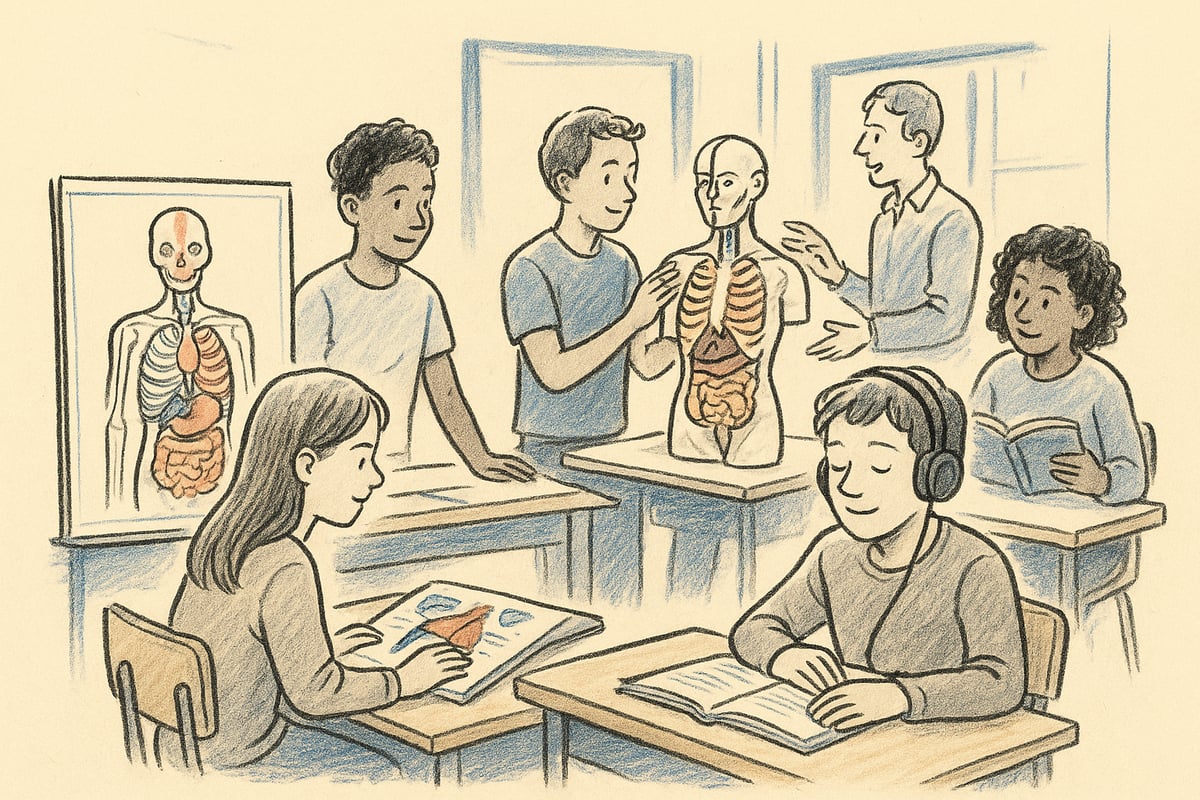
Identify different learning styles and preferences
Students have different ways of acquiring knowledge, which is crucial in teaching anatomy. Some learn best visually with posters and diagrams, while others prefer to listen to podcasts or recorded explanations. Kinesthetic learners benefit most from hands-on exercises where they can feel and explore models. For some, reading and writing through text materials and notes is the most effective approach. By offering a variety of materials and activities, you can accommodate all learning preferences and ensure that anatomy teaching is both relevant and engaging for the entire class.
The importance of motivation for learning
Motivation plays a central role in anatomy teaching. A distinction is made between intrinsic motivation, where curiosity and interest drive learning, and extrinsic motivation, where the focus is often on grades. Studies show that students with high motivation perform up to 30% better. However, study motivation among Danish students drops by 17% during the first year, which emphasizes the importance of addressing motivation in teaching ( Students' motivation drops during the first year of study ). Teachers should work actively to strengthen both intrinsic and extrinsic motivation through varied tasks and meaningful goals.
Typical challenges in anatomy teaching
Teaching anatomy can be challenging for many students. The complexity of the subject, the many Latin terms and abstract concepts can quickly seem overwhelming. In fact, 60% of medical students often feel pressured by the material and the amount of detail. To reduce this burden, it is important to structure the teaching into manageable units, use repetition and provide opportunities to ask questions continuously. By being aware of these challenges, anatomy teaching can be adapted to make it more accessible to all students.
Creating a safe and inclusive environment
A safe and inclusive learning environment is fundamental to successful anatomy teaching. Differentiated teaching, where tasks and materials are adapted to the individual student's level and needs, creates space for everyone. Open dialogue and recognition of diversity strengthens the community. Peer feedback and group exercises promote collaboration and respect in the classroom. When students feel seen and heard, their courage to participate actively and take responsibility for their own learning increases.
Feedback and ongoing evaluation
Constructive feedback is a cornerstone of effective anatomy teaching. Formative feedback, such as quizzes and reflection tasks, helps students adjust their understanding along the way. Summative feedback, such as exams and final tests, measures overall learning outcomes. A balance between the two forms creates a motivating environment where mistakes are seen as opportunities for learning. Ongoing evaluation strengthens engagement and ensures that anatomy teaching is always tailored to the current needs of students.
Teacher and student perspectives
The interaction between teacher and students is of great importance for the benefit of anatomy teaching. Experience shows that an interactive classroom environment, where students are engaged through questions and dialogue, increases both professional understanding and enjoyment of the subject. When students are given the opportunity to contribute actively, their self-confidence and sense of responsibility are strengthened. This creates a positive spiral where both professionalism and motivation thrive in anatomy teaching.
Innovative Learning Tools and Teaching Materials
New technologies and creative materials have significantly changed anatomy teaching in recent years. When teachers think innovatively, both understanding and motivation in students are strengthened. Modern learning tools make it possible to combine theory and practice, so that multiple senses are activated and complex concepts become easier to understand.
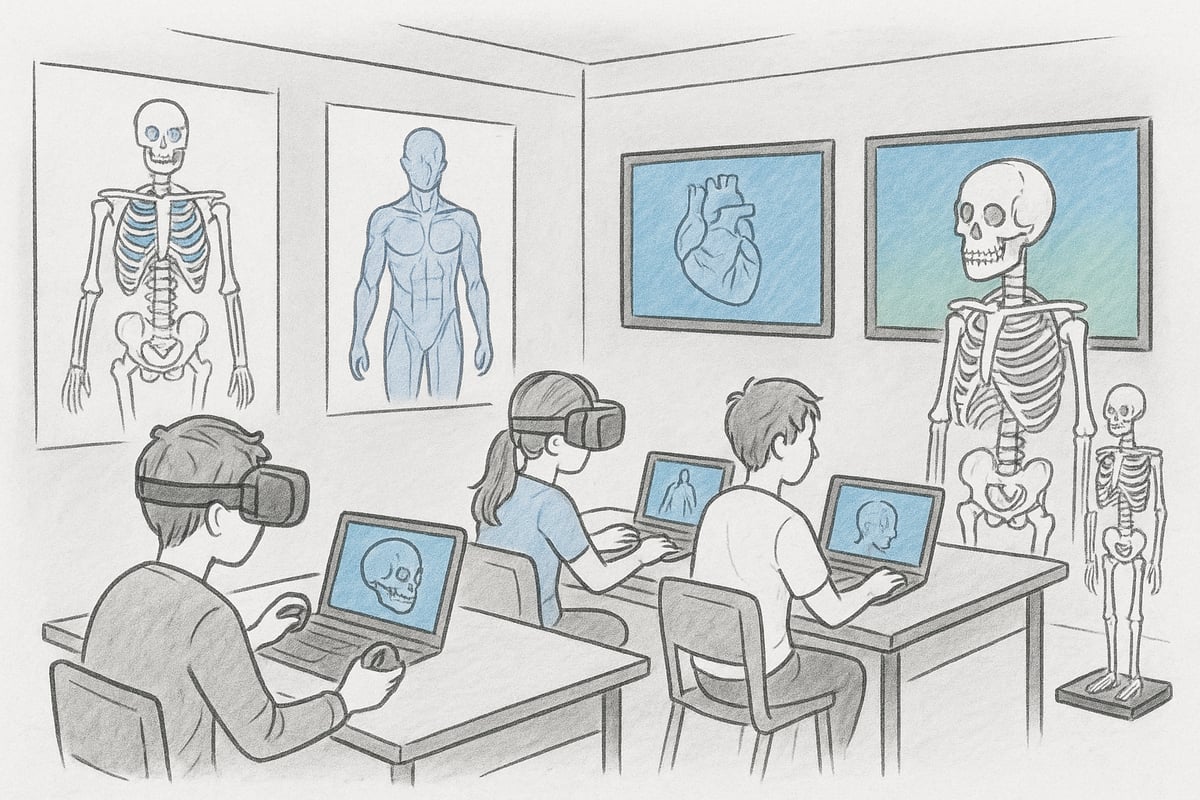
Modern teaching materials
The development of educational materials has opened up new possibilities in anatomy teaching. Interactive 3D models, posters, VR and AR apps, and digital platforms allow students to explore the structures of the body on multiple levels.
The use of virtual reality and augmented reality makes it possible to experience organs and anatomical systems in 3D. Digital platforms offer quizzes and visual exercises that activate both vision and interaction. Statistics show that as many as 75 percent of teachers experience increased engagement when interactive models are integrated into anatomy teaching.
Tactile and visual aids
Tactile and visual aids play a central role in effective anatomy teaching. Physical models, such as skeletons and organs, invite hands-on activities where students can feel and see the different structures.
Visual representations, such as posters and diagrams, help to create an overview of complex relationships. By combining multiple senses, learning outcomes are significantly enhanced. If you want inspiration for the use of physical models, you can read more about Didactic models for anatomy .
Adaptation to different educational levels
Effective anatomy teaching requires materials that match the students' age and abilities. At primary school level, colorful and simple models and large posters work best. Here it is important to create curiosity and recognition.
In higher education, materials should be more detailed, such as microscopic sections and advanced 3D models. Adaptation ensures that all student groups get the most out of anatomy education.
Selection of quality materials
The choice of teaching materials should always be based on quality, relevance and pedagogical value. Collaboration with experts ensures that the materials are correct and up-to-date.
It is important to choose ethical and sustainable products that can be used for many years. Teachers should consider whether the materials support differentiated anatomy teaching so that all students can actively participate and feel included.
eAnatomi ApS: Quality Models and Posters for Teaching
eAnatomi ApS offers a wide range of quality models and posters, developed in collaboration with healthcare experts. Their range ranges from simple skeletal models to detailed organ sets used at multiple educational levels.
The posters from eAnatomi ApS make it easy to create an inspiring learning environment and support differentiation in anatomy teaching. Many educators highlight how the use of physical models and visual aids increases engagement and understanding in the classroom.
Didactic Strategies for Effective Anatomy Teaching
Effective anatomy teaching requires thoughtful didactic strategies that engage students and adapt to their individual needs. By combining varied teaching methods, differentiation, and feedback, a dynamic learning environment can be created where all students have the opportunity to develop their understanding of anatomy.
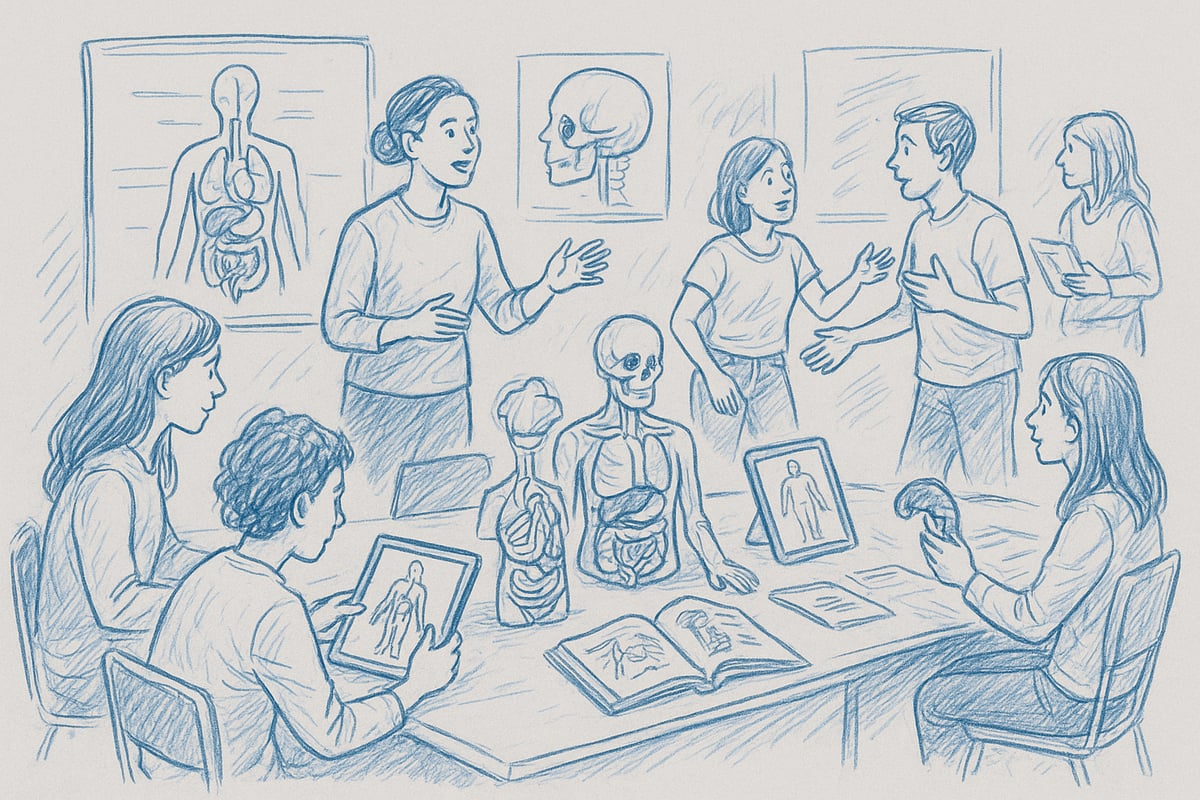
Activating teaching methods
Engaging teaching methods are central to modern anatomy education, as they promote active participation and increase understanding. Examples include case-based learning, where students work with concrete patient stories, and role-playing, where students take on different roles to illustrate anatomical processes.
Simulations, such as group dissection or the use of digital tools, make it possible to connect theory and practice. Group work strengthens collaboration and gives students the opportunity to explain and challenge each other's understanding of anatomy teaching. By engaging multiple senses and learning styles, teaching becomes more vivid and motivating.
Variation and differentiation
Variation and differentiation in anatomy teaching ensures that all students are challenged and supported at their level. By alternating between theory, practical exercises, discussion and self-study, motivation is kept high. The use of quizzes, models and reflection tasks makes it possible to adapt the teaching to both visual, auditory and kinesthetic learning preferences.
For inspiration on how to best vary and adapt anatomy teaching, read more tips for anatomy teaching , where you will find concrete advice for both teachers and students. By using different methods, more students experience success and professional development.
Problem-Based Learning (PBL)
Problem-based learning (PBL) is an effective approach to anatomy teaching, where students work with real-world problems. For example, they can analyze patient cases to understand how anatomical knowledge is applied in practice.
This method strengthens critical thinking and collaboration as students must independently identify relevant anatomical topics and seek solutions. PBL promotes deep learning and motivates students to actively engage in anatomy teaching.
Teaching differentiation
Differentiation of instruction means adapting instruction to students' individual levels, pace, and interests. In anatomy teaching, this can be done by offering supplementary materials, differentiated assignments, and extra support for those who need it.
The teacher can also allow students to choose between different presentation formats, such as oral presentations, models, or written assignments. This flexibility creates better conditions for all students to benefit from anatomy education.
Feedback and reflection
Effective feedback and reflection are essential for learning in anatomy teaching. Ongoing feedback from both teachers and fellow students helps students adjust their understanding and working methods.
Peer evaluation and self-reflection, for example through learning diaries or short reflection tasks, strengthen the sense of responsibility and allow students to identify their own strengths and areas for development. This contributes to a continuous learning process.
Creating commitment and responsibility
To increase engagement and responsibility in anatomy teaching, students should be actively involved in planning and evaluating the teaching. When students are given a say in the choice of topics or presentation formats, their motivation and ownership increase.
For example, students can choose whether to present a topic using models, digital presentations, or group work. This approach promotes creativity and strengthens the learning environment.
Collaboration across disciplines and levels
Interdisciplinary collaboration broadens the perspective in anatomy teaching. By combining anatomy with subjects such as biology, physical education or collaboration with health education, students gain a more holistic understanding.
Joint projects across subjects or educational levels create opportunities to apply anatomical knowledge in practice. This strengthens both the academic and social learning environment and prepares students for interdisciplinary collaboration in the future.
The Role of Technology in the Future of Anatomy Teaching
Technology is transforming anatomy education, creating new opportunities for learning, adaptation, and motivation. Digital tools, VR, and data analytics are making it easier for both students and educators to achieve deeper understanding and engagement. In this section, we take a closer look at how technological solutions are shaping the future of anatomy education.

Virtual and augmented reality (VR/AR)
Virtual and augmented reality have revolutionized anatomy education by bringing complex structures to life and in three dimensions. Students can explore organs, move around the body, and practice hands-on skills that might otherwise be difficult to acquire.
Advantages of VR/AR in anatomy teaching:
- Increased understanding through interactive visualization.
- Realistic simulations of complex processes.
- Opportunity for individual exploration at your own pace.
According to a systematic review of VR and AR in anatomy education, the majority of students experience greater understanding and motivation when using these technologies. VR/AR allows for experimentation, error, and repetition without risk, which strengthens the learning process.
Digital platforms and e-learning
Digital platforms are playing an increasingly important role in anatomy education. Online quizzes and learning apps allow for flexible training of knowledge, while adaptive systems adjust the difficulty level to the individual student's level.
Examples of digital tools in anatomy teaching:
- Anatomical quizzes with instant feedback.
- Digital flashcards for repeating terms.
- Video lectures and interactive assignments.
The digital approach supports both self-study and collaboration, making anatomy teaching more accessible and engaging for different types of learners.
Hybrid and blended learning models
Hybrid and blended learning combines the best of physical and digital anatomy education. Students can participate in classroom instruction, but also work independently online with assignments and simulations.
Advantages of hybrid models:
- Flexibility in time and place.
- Possibility to customize learning courses.
- Greater inclusion of individual preferences.
In anatomy teaching, this approach creates a better balance between theory, practice, and reflection. It opens up for differentiation and increased student responsibility, which strengthens learning outcomes.
Data-driven teaching
Data plays a central role in the future of anatomy education. By analyzing results from quizzes, assignments, and digital platforms, teachers can identify strengths and challenges in individual students.
Examples of data-driven practice:
- Adjustment of teaching based on learning data.
- Targeted support for students with needs.
- Overview of the class's overall progress.
Data enables ongoing adaptation of anatomy instruction to ensure that all students benefit from it, creating a more inclusive and effective learning environment.
Challenges and limitations
Although technology has many benefits, there are also challenges in anatomy teaching. Access to equipment, cost, and the need for teacher training can limit implementation.
Typical challenges:
- Lack of technological infrastructure.
- Need for competence development among teachers.
- Risk of digital pressure and inequality.
The solution lies in targeted continuing education, prioritization of relevant tools, and support for both students and teachers. With the right approach, technology can improve the quality of anatomy education for everyone.
Physical Design and the Importance of the Learning Environment
A well-designed learning environment is essential for creating the framework for engaging and effective anatomy teaching. The physical space affects concentration, collaboration, and students' desire to explore the material. With the right design, you can support different learning needs and create an inclusive environment where knowledge grows.
Classroom layout
The layout of the room should reflect the purpose of teaching anatomy. Flexible furniture makes it easy to switch between group work and individual immersion. Tables can be brought together for collaboration, or separated for peace and concentration. It is important to have easy access to models, posters and digital resources so that teaching can be quickly adapted to different activities.
Consider placing stations for hands-on exercises where students can work with physical materials. An inspiring environment promotes creativity and interest in anatomy teaching.
Visual learning environments
Visual elements create an overview and strengthen the understanding of complex topics. Anatomy posters on the walls allow students to orient themselves in the structures and relationships of the body. Using large posters can be an effective way to present detailed knowledge, and they function both as decoration and as a learning tool.
Read more about decorating with anatomy posters and see how they can be integrated naturally into the classroom to promote learning.
Digital displays and models can complement physical materials and create dynamic presentations.
Practical workstations
Hands-on workstations are central to anatomy education, allowing students to experiment and investigate. Create zones with equipment for dissection, modeling, or using 3D models. Make sure materials are easily accessible and safety is paramount.
A clear division of work areas helps students focus and increases their engagement. Such stations make it easier to vary teaching methods and adapt them to different learning styles.
Sound, light and climate
A good physical learning environment also depends on acoustics, lighting and indoor climate. Good lighting, both natural and artificial, is important to promote concentration and reduce fatigue. The acoustics must be adapted so that everyone can hear clearly without noise disturbances.
Ensure that the room is ventilated and has a comfortable climate all year round. This supports well-being and helps to make anatomy teaching a positive experience for all students.
Inclusive and safe atmosphere
A safe atmosphere is the foundation for learning. The design should encourage dialogue, collaboration, and respect for diversity. Create spaces where students can exchange ideas and give each other feedback.
Diversity and accessibility must be considered so that everyone feels welcome and has equal access to the teaching. An inclusive environment makes anatomy teaching meaningful and motivating for the entire class.
Evaluation, Feedback and Continuous Improvement
Effective evaluation and feedback are essential to optimize the benefits of anatomy teaching. A well-structured approach helps both teachers and students identify strengths and areas for development, so that the learning process is continuously improved.
Formative and summative evaluation
In anatomy teaching, it is important to balance formative and summative assessment. Formative assessments, such as ongoing quizzes and short tests, help students adjust their learning strategies as they go. Summative assessments, such as final exams or project work, measure overall achievement. Using both forms ensures that students’ understanding is developed systematically.
| Evaluation type | Purpose | Examples |
|---|---|---|
| Formative | Support learning | Quizzes, reflection tasks |
| Summative | Measuring yield | Exams, final projects |
This approach makes it possible to adapt anatomy teaching to the students' current needs and progression.
Feedback culture
A constructive feedback culture is the foundation for professional growth in anatomy teaching. Continuous feedback from both teachers and fellow students motivates, increases self-confidence, and strengthens the professional community. Peer review of assignments or presentations is an effective tool for students to develop critical thinking and learn from each other.
To create an open dialogue, feedback should be given regularly, be specific, and always focus on development, not just on the result.
Self-evaluation and reflection
Reflection plays a central role in anatomy teaching. When students evaluate their own performance, they gain greater insight into their own strengths and weaknesses. Self-evaluation can be done through learning diaries, reflection forms, or short self-assessments after assignments.
This practice helps students set realistic goals and strengthens their ability to take responsibility for their own learning.
Adjustment of teaching based on evaluation
Ongoing evaluation provides the teacher with valuable insight into how anatomy teaching works in practice. By analyzing results from tests, assignments, or feedback, teaching methods and materials can be adjusted in a targeted manner. For example, it may be necessary to change the pace or focus areas so that all students are challenged at the right level.
Adjustments based on solid evaluation ensure that teaching remains relevant and effective.
Involving the student voice
When students are actively involved in the evaluation of anatomy teaching, both motivation and engagement increase. Questionnaires, interviews and discussions about the teaching provide valuable insight into what works and where there is room for improvement.
Co-ownership of the learning process motivates students to take responsibility and contributes to a more inclusive learning environment.
Future Trends in Anatomy Teaching
The future of anatomy education is changing dramatically, with technology, interdisciplinary collaboration, and global collaboration shaping both teaching methods and learning environments. To ensure student motivation and learning outcomes, it is crucial to follow the latest trends and adapt to a constantly changing world.
Integration of artificial intelligence and adaptive learning
Artificial intelligence is increasingly playing a role in anatomy education. AI-based platforms analyze individual learning patterns and adapt tasks to address students' strengths and weaknesses. This makes it possible to create personalized learning paths that challenge both beginners and advanced students at the right level.
Furthermore, adaptive learning allows for continuous feedback and adjustment of content, which strengthens the learning effect. Digital tools and simulations, such as interactive learning with virtual reality , support this development and make it possible to visualize complex anatomical structures in practice.
Increased focus on interdisciplinarity and practicality
Anatomy education is moving towards a more practical and interdisciplinary approach. Collaboration with clinical and technological disciplines creates a deeper understanding of the real-world significance of anatomy. Projects where students work together with healthcare professionals or companies provide concrete experiences and strengthen the link between theory and practice.
Interdisciplinary courses also promote communication and collaboration across professional groups, which is crucial in the modern healthcare system.
Sustainability and ethical considerations
Sustainability plays a major role in anatomy education. The choice of teaching materials should not only be academically relevant, but also ethically and environmentally sound. Many institutions are choosing digital materials over physical ones where possible, which reduces resource consumption.
At the same time, emphasis is placed on ethical teaching, where students reflect on the use of biological material and the ethical aspects of simulations and digital solutions.
Globalization and international cooperation
Anatomy education is becoming more globalized. Exchange of materials and experiences between countries provides access to new perspectives and pedagogical methods. International projects and digital conferences strengthen the professional network and inspire innovation.
Cross-border collaboration makes it possible to learn from best practices and develop teaching that is adapted to a global reality.
Lifelong learning and continuing education
Lifelong learning is a central trend in anatomy education. Both teachers and students are offered ongoing refresher courses and online modules to ensure that their skills are always up-to-date. Continuing education ensures that teaching keeps pace with technological and professional developments.
Flexible learning paths that can be adapted to individual needs make it possible to stay up-to-date throughout your career.
When you want to create a vibrant anatomy education, choosing the right materials and methods is crucial for both motivation and learning outcomes. We have seen how innovative models, posters and digital solutions can elevate teaching to new heights and make even complex topics more accessible. At eAnatomi ApS, we collaborate with healthcare specialists to develop quality products that support both differentiation and engagement in teaching. If you want to know more about how you can strengthen your anatomy education with the best tools and latest trends, you can Read more here .
0 comments