

Imagine sitting in front of a giant anatomy book and trying to remember countless names, structures, and functions. Many people find it overwhelming to keep track of all the details in the world of anatomy.
The purpose of this article is to make it easier for you. Here are 7 brilliant mnemonics for memorizing anatomy so you can master even the most complex topics in 2026.
Mnemonic rules are not only for students, but also for professionals and anyone working with anatomy. Effective techniques can make learning faster, more enjoyable and more lasting.
Are you ready to take control of your learning? Read on and discover concrete tips that will enable you to memorize anatomy successfully.
Why Are Mnemonics So Effective for Learning Anatomy?
Learning anatomy requires you to remember hundreds of details, structures, and relationships. Many students find that rote memorization can be overwhelming. This is where anatomy memorization mnemonics come into play as an effective solution. But why do they work so well? The answer lies in the way our brain processes and stores information.
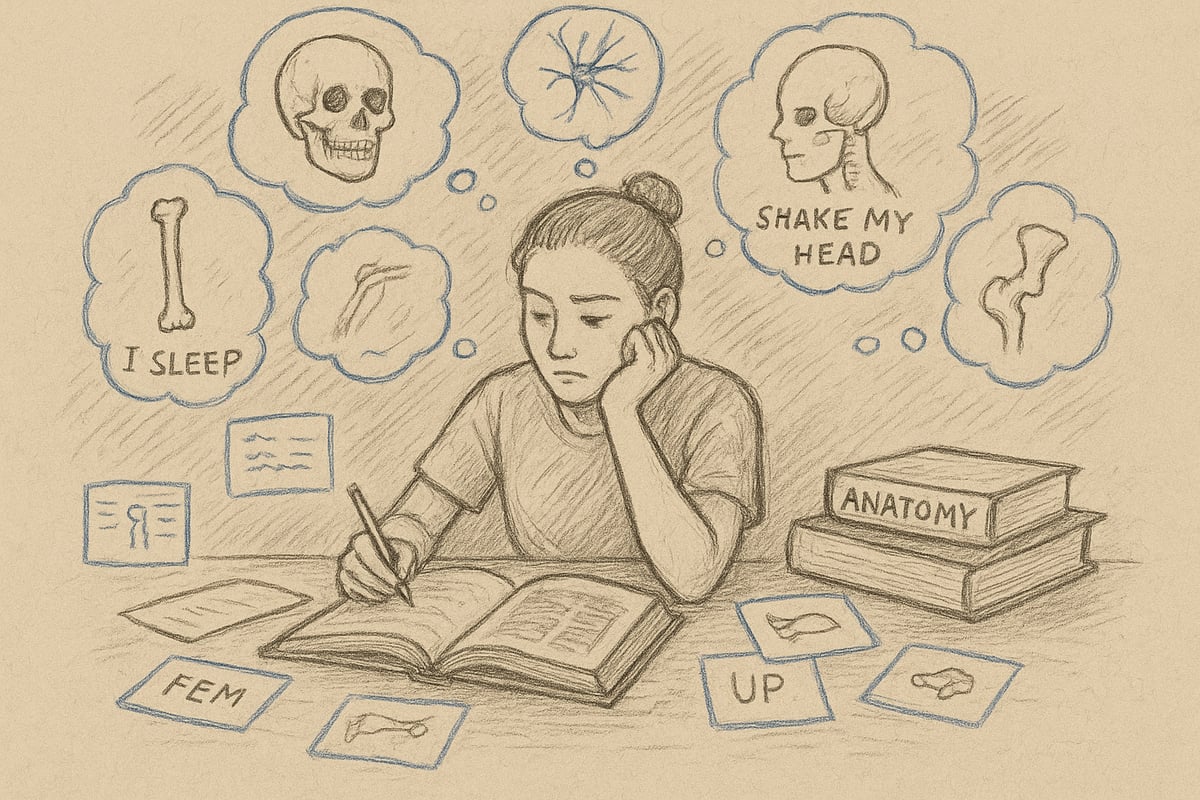
What is a mnemonic?
A mnemonic is a tool that helps you store and recall information in a simple way. When it comes to mnemonics for memorizing anatomy, techniques can range from classic mnemonics, funny rhymes and jokes to visual images and acronyms.
Mnemonics are collective terms for methods where you use association, sound or images to remember difficult information. Acronyms are abbreviations where each letter stands for an anatomical concept, while rhymes and rhymes use rhythm and sound to retain knowledge.
An example from anatomy teaching is “Never Let Monkeys Eat Bananas” to remember the order of leukocytes. In Danish, rhymes such as “Five small bones in the hand, remember them with this edge” are used. Modern mnemonics for memorizing anatomy can also be digital or visual.
Many medical students find inspiration in books such as Memorable Rules for Medical Studies by Tor-André Liane , where the techniques are specifically targeted at memorizing anatomy.
Scientific basis for mnemonics
Research clearly shows that mnemonics for learning anatomy by heart significantly improve memory. Studies from Medical Education (2022) document that students who use mnemonics can remember up to 30 percent more details than their fellow students.
The brain works best when new knowledge is linked to already known associations. When you use rhymes, images, or acronyms, more areas of the brain are activated. This helps you retain information in both short- and long-term memory.
An overview of techniques:
| Technique | Characteristics | Example in anatomy |
|---|---|---|
| Mnemonics | Use of association, sound, images | “SITS” for shoulder muscles |
| Rhymes/Strips | Rhythm and repetition | “Five little bones in the hand” |
| Acronyms | Abbreviations | “NAVL” for the inguinal canal |
| Visual maps | Colors, charts | Color coding of nerves |
When you combine techniques, the effect is further increased. Mnemonics for memorizing anatomy are based on well-documented cognitive mechanisms.
Benefits of mnemonics in anatomy
The benefits of using mnemonics to memorize anatomy are many. First of all, you save time because you can repeat complex lists or structures more quickly. Repetition through rhymes or acronyms allows you to retrieve knowledge more quickly when you need it.
Another benefit is increased self-confidence. When you experience that mnemonics for memorizing anatomy work, you become more motivated to learn and engage with the material. This creates a positive spiral where you dare to challenge yourself with more difficult topics.
Studies also show that medical students who regularly use mnemonics to memorize anatomy perform better on exams. This effectiveness is due to their ability to recall key information quickly and reliably, which enhances performance in pressured situations.
Challenges and limitations
While mnemonics for learning anatomy by heart are effective, they also have limitations. It is important to remember that understanding should always take precedence over pure memorization. If you focus only on the strips without understanding the content, you risk losing the overview.
Sometimes, too many or too complicated mnemonics for memorizing anatomy can create confusion. It can also lead to you mixing up concepts if the rules are not personal or relevant to you.
Therefore, it is important to choose anatomy memorization mnemonics that suit your own learning style, and always combine them with understanding and practical application. This way, you will get the most out of your efforts and ensure that the knowledge sticks when you need it.
7 Brilliant Mnemonics for Memorizing Anatomy 2026
Memorizing anatomy can feel like climbing a mountain, but with the right anatomy memorization strategies, the process becomes both easier and more engaging. Here are seven methods that will help you master even the most complex details. Whether you're a student, a teacher, or a clinical professional, these strategies will help you retain knowledge effectively.
Rhymes and Strips: Make Complex Knowledge Easy to Remember
Rhymes and rhymes are classic mnemonics for memorizing anatomy. When you connect knowledge to rhythm and rhyme, it becomes easier for the brain to retain and recall structures.
A good example is the English "Never Let Monkeys Eat Bananas", which is used to remember the order of leukocytes. In Danish, you can make similar strips, for example. "Bone, muscle, nerve, vein - this is how I remember one and the other one". By incorporating rhymes into your mnemonics for memorizing anatomy, you strengthen long-term memory and reduce the risk of confusing concepts.
Advantages of rhymes and strips:
- Make complex information more understandable.
- Promotes auditory learning.
- Easy to share and use with other students.
Tips for creating your own rhymes:
- Use short, simple sentences.
- Incorporate humor or images that stick.
- Repeat the strips aloud so they are stored better.
Rhymes and rhymes are especially good if you learn best through sound and repetition. Combine them with other mnemonics to memorize anatomy for the best effect.
Acronyms: Create Your Own Abbreviations
Acronyms are among the most popular mnemonics for memorizing anatomy. By taking the first letters of a series of anatomical names, you can create short words or phrases that quickly activate your memory.
A classic example is "SITS" for the four muscles of the rotator cuff: Supraspinatus, Infraspinatus, Teres minor, and Subscapularis. In 2026, many medical students still use acronyms like "SLAP" for shoulder labral tears or "VAN" for Veins, Arteries, and Nerves, in that order.
How to create your own acronyms:
- Write the list of anatomical concepts you want to remember.
- Take the first letter from each word.
- Make a meaningful or funny word out of them.
Warning: Avoid outdated or confusing acronyms. Always check that your anatomy memorization rules make sense to you and are appropriate for the task.
Acronyms are particularly useful for remembering sequences or groups of structures. Use them in addition to rhymes, images, or other techniques to maximize your learning.
Visual Memorization Rules: Use Images and Color Codes
For many, visual mnemonics are essential for memorizing anatomy. Colors, images, and diagrams help the brain organize and retain details.
For example, you can color-code nerve pathways on posters or create mind maps of organ locations. Using digital tools, such as flashcard apps or 3D visualization, makes it both fun and effective. According to Learning Styles Research (2023), 65 percent of learners learn best visually, which underlines the value of this method.
Examples of visual techniques:
- Draw your own diagrams with different colors for each structure.
- Make tables comparing bones, muscles or nerves.
- Use posters or anatomical models to see the whole picture.
Apps and digital platforms like Anki or Quizlet let you build visual mnemonics to memorize anatomy in your own way. Remember to combine visual elements with other learning styles to strengthen your memory.
Storytelling: Create Coherent Narratives
Storytelling is a creative way to use mnemonics to memorize anatomy. By putting information into small stories, you create meaning and coherence that the brain can more easily retain.
A classic example is to explain the path of blood through the heart as a small journey: "The blood enters the right atrium, takes the elevator down into the right ventricle, is sent to the lungs to pick up oxygen, and then returns to the left atrium, ready for another round." This technique makes it easier to remember sequences and relationships.
Benefits of storytelling:
- Increases understanding and not just rote learning.
- Make learning more fun and engaging.
- Creates images that are easy to recall under pressure.
Tips for creating your own stories:
- Use analogies from everyday life.
- Incorporate humor or dramatic elements.
- Repeat the stories to yourself or others.
When you use storytelling as a mnemonic to memorize anatomy, knowledge becomes vivid and easier to recall, especially during exams.
The Location Method: The Memory Palace
The location method, also known as the memory palace, is one of the most advanced mnemonics for memorizing anatomy. It places information in specific spaces or places in your imagination, making it easy to "go for a walk" and retrieve the knowledge.
How to build a memory palace:
- Imagine a familiar place, such as your childhood home.
- Assign each room an anatomical structure (e.g. the brain in the living room, the heart in the kitchen).
- Mentally walk through the house and recall the information in order.
Example: To remember the digestive system, you can place the organs in different rooms so that you follow the food all the way through the body. Research in Cognitive Psychology (2021) shows that this technique can increase retention of details by up to 50 percent.
The location method requires some practice, but as a mnemonic for memorizing anatomy, it is unbeatable if you need to remember large amounts of information in the correct order.
Iteration and Active Testing: Learn By Doing
Repetition and active testing are two of the most effective mnemonics for memorizing anatomy. By repeating knowledge at regular intervals and actively testing yourself, you strengthen both learning and retention.
Use flashcards, quizzes, or peer-to-peer testing to identify weak points. "Spaced repetition" – where you spread out the repetitions over time – helps you move knowledge from short-term to long-term memory.
Examples of active testing:
- Make your own flashcards with both questions and answers.
- Use quiz apps where you can compete with yourself or fellow students.
- Test each other in the study group.
The benefits of these mnemonics for memorizing anatomy are clear: You quickly discover what is stuck and what needs to be refreshed. At the same time, you strengthen your self-confidence and reduce exam anxiety.
Physical Learning: Use Movement and Practical Exercises
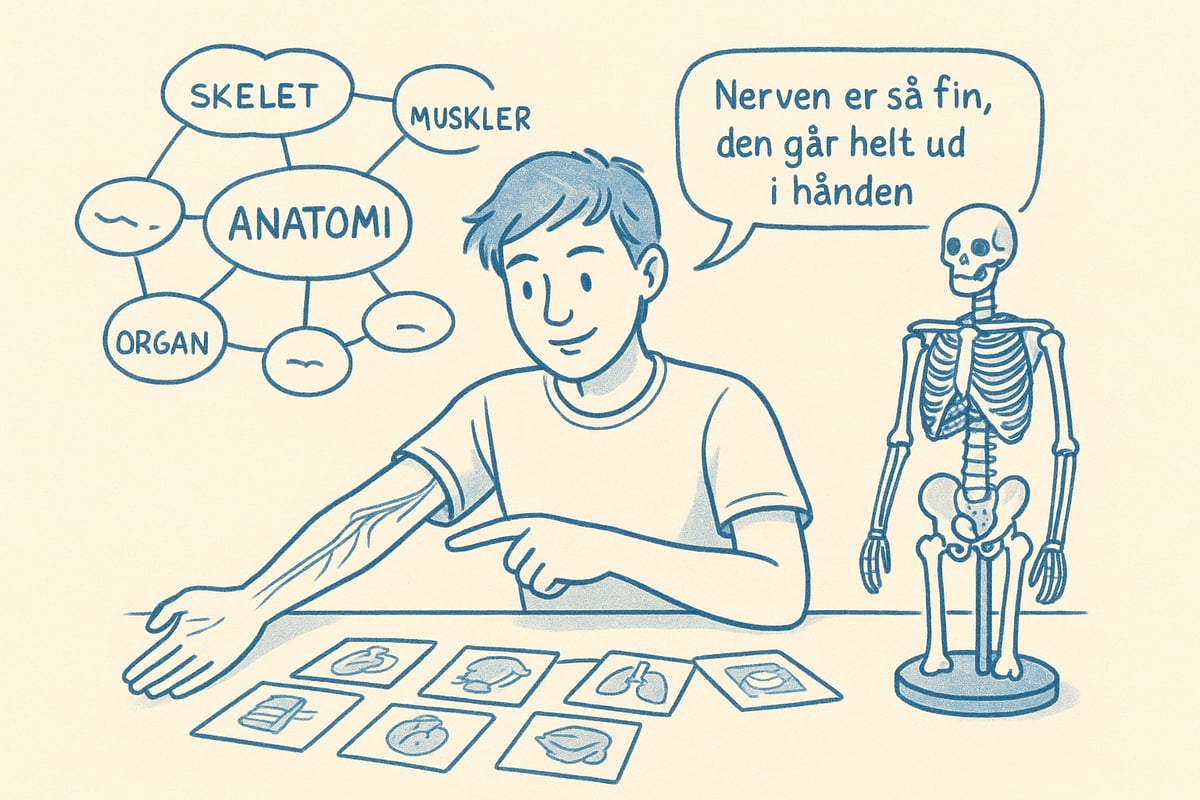
Physical learning is an underrated approach, but as a mnemonic for memorizing anatomy, it has a great effect. By involving the body and using practical exercises, you connect theory with action.
For example, you can point to your own muscles, follow nerve pathways on the body, or work with 3D models of organs. This hands-on approach activates multiple senses and makes it easier to remember location and function.
Examples of physical learning:
- Use anatomical models to feel and see structures.
- Mimic movements that activate specific muscles.
- Draw the location of the organs directly on the skin with crayons.
Bodily learning is especially useful for kinesthetic learners and those who learn best through activity. To get the most out of this method, you can find inspiration at Anatomical Models for Learning , where you can access models that support both visual and practical mnemonics for memorizing anatomy.
By combining body-based learning with the other techniques in this list, you will achieve a deeper understanding and better retention of anatomical knowledge.
How to Combine Multiple Mnemonics for Better Results
Mastering anatomy requires more than just one method. When you combine multiple mnemonics to memorize anatomy, you achieve a much deeper understanding and better retention of the material. Here you will gain insight into why precisely the combination of different techniques can elevate your learning to the next level.

The advantages of combining methods
The combination of several mnemonics for memorizing anatomy creates a synergistic effect where different learning styles support each other. When visual, auditory, and kinesthetic techniques are used together, complex topics become easier to understand and remember.
For example, you can combine a rhyme with a color-coded poster, so that both sound and image work together in your memory. Many students find that stories or analogies, supplemented with mind maps or flashcards, make it easier to retain even the most difficult details.
A case study from the Journal of Medical Education (2024) shows that students who use multiple mnemonics to memorize anatomy score 20% higher on average on exams. If you want more resources for combining techniques, you can find inspiration at Study Help for New Students , which brings together guidance and materials for effective anatomy learning.
Practical strategies for integration
How do you best plan to use multiple mnemonics to memorize anatomy? Start by identifying your strengths: Do you best remember through images, sound, or movement? Try varying between rhymes, color-coded diagrams, and active testing to keep your brain engaged.
Create a weekly study plan where you alternate between different techniques. For example: Monday you work with flashcards, Wednesday you make rhymes and strips, Friday you draw mind maps. This way you avoid routine and stimulate your memory from multiple angles.
It is also worth evaluating which combinations work best for you. Note which methods give the most benefit, and adjust along the way. Many students use Self-study – Anatomionline.dk to get inspiration for combining techniques and structuring their learning.
Mistakes and pitfalls when combining
While combining mnemonics to memorize anatomy is effective, there are also challenges. Too many techniques at once can create confusion and overload. Therefore, it is important to choose the methods that feel most natural to you.
Avoid trying everything at once. Instead, choose a few relevant and personal mnemonics to memorize anatomy, and build gradually. Remember that the quality of your learning is often more important than the quantity of techniques.
Reflect on what works and don't be afraid to adjust your approach to ensure that your anatomy memorization mnemonics are a help, not a hindrance.
Tips for Maintaining Motivation and Structure Along the Way
Staying motivated when working with anatomy mnemonics can be a challenge in itself. Many students experience periods of doubt, fatigue, or lack of overview. Below you will find specific advice to help you stay on track and get the most out of your anatomy mnemonics.

Motivational techniques for anatomy students
Start by setting very specific goals for your learning of anatomy mnemonics. Break down large goals into smaller sub-goals, and mark your progress each time a sub-goal is achieved. This could be anything from learning all the bones of the skull to being able to list the courses of the nerves.
Use study groups or online communities to create accountability and support. Many people find it easier to stick with a goal when they share their challenges and successes with others. Social media or apps can also help you visualize your progress and celebrate small victories.
If you need additional aids or inspiration for new memory rules to memorize anatomy, you can find a wide selection of relevant materials at Aids for Medical Students .
Structure and planning
A realistic study plan is key to success with anatomy memorization mnemonics. Start by assessing how much time you have available and spread the topics out over several weeks. Incorporate breaks and active learning to avoid getting bogged down along the way.
Create a weekly schedule with fixed times for revision and testing. Feel free to use color codes or visual aids, such as muscle posters and flashcards, to make your structure more manageable. Consider getting inspiration from Notes for the 2nd semester | Aarhus University to see how others structure their anatomy learning.
Introduce a reward system where you treat yourself after achieving your goals. Small breaks and rewards make it easier to maintain focus and energy.
Dealing with adversity
Even with the best anatomy memorization tools, you will encounter periods when your motivation dips. It's important to accept that setbacks are a natural part of the learning process. Use setbacks as an opportunity to adjust your approach, rather than giving up.
Take time for self-care and mental balance. Short walks, good sleep, and healthy routines will help you regain your energy. Remember that persistence and patience are essential when working with mnemonics to memorize anatomy.
If you are experiencing prolonged adversity, seek support from your fellow students, teacher, or a mentor. Sharing challenges often makes them easier to deal with.
Once you see how much easier it becomes to memorize anatomy with the right mnemonics, you'll want to take your knowledge to the next level. Whether you're a student or a professional working with anatomy, you can create greater overview and confidence in your learning by combining several of the methods we've reviewed here. If you want to dive even deeper and get access to unique models and posters that make your learning both visual and engaging, you can always Read more here and find inspiration for your further journey.
0 comments